Subcon Subscriptions Explained: How Subcom Powers Predictable E‑Commerce Growth
Subscriptions have moved into the mainstream, and 68% of consumers subscribed to a new service for the first time in 2024, which shows how rapidly recurring models like subcon subscriptions are reshaping online retail.
Key Takeaways
What are subcon subscriptions / Subcom?
Subcon subscriptions, often called
Subcom (subscription commerce), are e‑commerce models where customers pay on a recurring basis to receive products or services automatically, as explained in detail in our guide on
subscription commerce.
How do recurring payments work in subscription e‑commerce?
Recurring billing relies on integrated payment gateways and automation so that charges repeat monthly, quarterly, or annually without manual invoicing, similar to the setups we describe on our
recurring and subscriptions payments page.
Can any online store use a subscription model?
Most modern platforms can support Subcom, especially if the store is built with flexible
ecommerce website design that includes subscription functionality and recurring billing.
What does it cost to launch a subscription‑ready store?
How do we keep a Subcom store secure and online?
Where can I learn more about building a full subscription solution?
2. How Subcon Subscription Models Work Behind the Scenes
Every effective Subcom store rests on three pillars: recurring billing, automated order fulfilment, and customer account management. We tie these together inside the shopping cart and payment gateway so that the workflow is seamless for both us and the customer.
Once a customer selects a subscription product, chooses an interval, and completes checkout, our system creates a recurring payment profile. The gateway then schedules future charges and sends confirmations without manual intervention from our team.
Core components of a working Subcom flow
Subscription product setup with options for weekly, monthly, quarterly, or annual cycles.
Recurring payment integration that can securely store billing details and trigger future charges.
Automated fulfilment rules that generate orders, pick lists, and shipping labels on the correct dates.
Self‑service customer accounts where subscribers can pause, upgrade, or cancel.
We explain the payment side of this in more detail in our recurring billing content, but in practice the customer simply sees a reliable service that "just works". Internally, automation handles the repetition so that our team can focus on product quality and communication instead of chasing payments.
3. Recurring Billing: The Financial Engine of Subcon Subscriptions
Recurring billing is the financial core of any Subcom model, because it governs how and when customers are charged. We integrate subscription‑enabled gateways that can process repeat payments without storing sensitive data on our own server.
For subcon subscriptions we usually choose between two structures: fixed recurring subscriptions and ad hoc recurring billing. Fixed subscriptions charge on a predictable cycle, while ad hoc billing lets us trigger charges programmatically when usage or milestones are reached.
Why recurring billing matters for revenue stability
From our perspective, recurring billing brings predictability and reduces the administrative cost of invoicing and collections. Instead of chasing hundreds of individual orders, we manage a portfolio of subscribers with known billing dates and behaviours.
It also becomes easier to model upgrades, downgrades, trials, and discounts at the level of subscription plans. That flexibility supports experimentation, which is very difficult when everything is sold as a once‑off transaction.
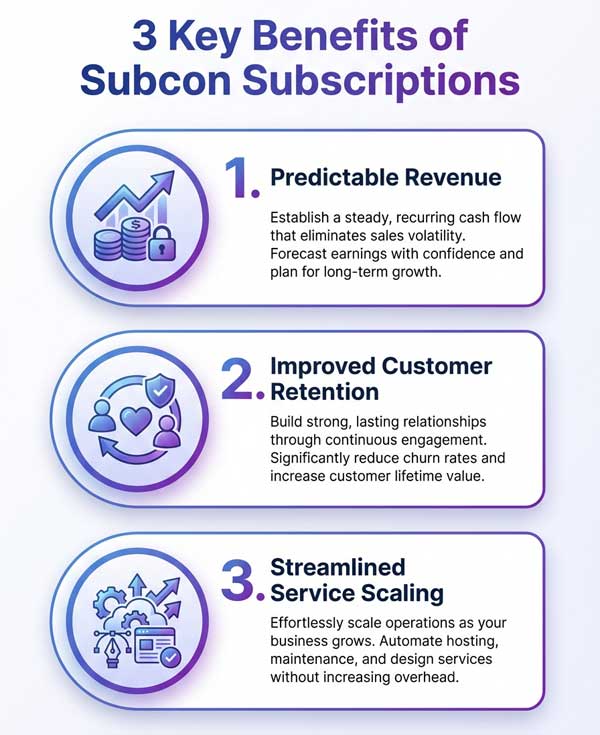
This infographic highlights the three key benefits of Subcon Subscriptions for your business. Learn how it can improve efficiency and save costs.
Did You Know?
Pause options surged 68% year-over-year, and 71% of merchants now offer both monthly and annual plans in their subscription models.
Source: Recurly — 2025 State of Subscriptions
4. Customer Experience in Subcom: Convenience, Choice, and Control
For subcon subscriptions to thrive, the customer experience must feel effortless and in control. Subscribers should be able to join, pause, change, or cancel without friction or hidden conditions.
We design the interface and journeys so that users can manage their subscription from a clear account dashboard. This aligns with customer expectations, especially in markets where people already manage streaming, meal kits, and other subscriptions.
What customers expect from a Subcom experience
Transparent pricing, including shipping and renewal dates, before they commit.
Easy plan changes so they can upgrade, downgrade, or skip a shipment in a few clicks.
Reliable communication, such as reminder emails before billing and dispatch notifications.
Consistent product quality that makes them feel the subscription is worth keeping.
Subcon subscriptions perform best when customers feel they are getting ongoing value, not being locked in. That is why our retention strategies focus on clarity, ongoing improvements, and regular feedback loops.
5. Real‑World Subcom Examples: From Fashion to Food and Homeware
Subcon subscriptions are not limited to a single industry, and we already see Subcom‑ready concepts in fashion, food, gaming, homeware, and more. The underlying pattern is simple: any product or service that customers use regularly can be turned into a subscription.
Below are types of businesses that can adopt Subcom models using the same recurring infrastructure, even if the products look very different on the surface.
Subscription use cases across industries
Fashion and apparel: curated clothing drops or wardrobe essentials on a schedule.
Food and meal kits: weekly or monthly delivery of ingredients, spices, or ready‑made meals.
Homeware and consumables: cleaning products, candles, and decor items shipped monthly.
Gaming and hobby items: accessories, cards, or collectibles in recurring boxes.
Each of these cases uses the same Subcom foundation, but with different packaging and frequency. We can start with a small subset of products and expand as we understand customer preferences and operational capacity.
6. Designing a Subscription‑Ready E‑Commerce Store
From a technical perspective, a successful Subcom implementation starts with robust ecommerce website design. We build the front end so that subscription options are clear, and the back end so that billing, shipping, and inventory align with recurring cycles.
Navigation and layout matter, because customers must understand the difference between one‑off purchases and subscriptions at a glance. We also ensure that mobile layouts handle subscription selection and account management without confusion.
Key design elements for subcon subscriptions
Clear product layouts that show "subscribe and save" options alongside once‑off purchases.
Category and search structures that highlight subscription‑friendly ranges like refills or bundles.
Checkout flows optimised for recurring billing fields and consent.
Trust signals around payment security and cancellation policies.
When we include subscription commerce at the design stage, we can avoid retrofitting awkward add‑ons later. That also keeps the customer journey smooth and reduces support requests around how Subcom works in practice.
Did You Know?
The average consumer had 8.2 subscriptions in 2024 and spent about $118 per month, or roughly $1,416 per year, across these services.
Source: Whop — 100+ Subscription Statistics for 2026
7. Building and Hosting Subcon Subscription Stores at Different Price Points
One misconception about Subcom is that it always requires large budgets or enterprise tools. In reality, we can launch subscription‑capable ecommerce sites using structured packages that match different stages of growth.
For example, our affordable online webshop options range from a Basic store around R5950 to a Big store around R7550. Each tier can include subscription support, hosting, and ongoing updates so that you do not carry the technical overhead alone.
Example: affordable subscription‑ready packages
| Package | Typical Price (ZAR) | Subscription Capability |
|---|
| Basic Online Webshop | R5950 | Suitable for starting simple subcon subscriptions. |
| Mid‑tier Online Webshop | R6650 | More products and flexibility for bundled Subcom offers. |
| Big Online Webshop | R7550 | Best for larger catalogues and multiple subscription tiers. |
These packages illustrate that Subcom can be accessible even to smaller South African businesses. We pair development with managed hosting and maintenance so that the subscription engine stays fast and secure as it scales.
8. Maintenance, Security, and Performance for Subcom Stores
Subcon subscriptions only work if the store is available and secure at the moments when recurring payments run. Downtime or security issues during billing cycles can lead to failed charges, churn, and support overhead.
We approach Subcom with a maintenance mindset that includes updates, backups, performance tuning, and security hardening. Subscription commerce is continuous by nature, so the underlying platform must stay healthy all the time.
Why maintenance matters more with recurring income
Downtime costs compound when missed charges need manual recovery and re‑billing.
Security updates protect stored customer data and payment tokens used for recurring billing.
Speed optimisation keeps account dashboards and checkout snappy for returning subscribers.
Monitoring helps us spot failed payment patterns before they snowball into churn.
Our maintenance packages can start around R185, which is low compared to the potential revenue at risk in a growing Subcom portfolio. We treat that cost as an insurance policy for both reputation and recurring income streams.
9. Retention, Churn, and Customer Lifetime Value in Subcon Subscriptions
The financial success of Subcom is less about how many people sign up initially and more about how long they stay. Retention, churn, and reactivation are therefore key metrics in any subcon subscription strategy.
We encourage clients to track churn reasons carefully, then adjust product quality, communication, or pricing. We also use win‑back campaigns for customers who paused or cancelled, especially when their original experience was positive.
Retention strategies that work well for Subcom
Loyalty rewards that recognize long‑term subscribers with discounts or exclusive items.
Flexible pausing so customers can skip a billing cycle instead of cancelling completely.
Proactive support when payment methods fail, to avoid involuntary churn.
Regular product updates to keep the subscription feeling fresh and relevant.
We design our Subcom implementations so that these tactics are technically easy to apply. That includes building tagging systems, email triggers, and loyalty structures that are subscription aware.
10. Scaling and Optimising Subcom: From First 50 Subscribers to Thousands
Once a Subcom model is running, the next objective is to scale without losing reliability or customer satisfaction. That requires attention to infrastructure, operations, and analytics.
On the infrastructure side, managed hosting with enough capacity ensures that spikes in billing or traffic do not slow down the store. On the operational side, we refine fulfilment processes and supplier relationships to handle higher subscription volumes.
Practical steps to scale subcon subscriptions
Standardise subscription SKUs so inventory and forecasting stay simple as you grow.
Automate more workflows, such as renewals, failed payment follow‑ups, and shipping label generation.
Segment subscribers by tenure or behaviour to tailor offers and communication.
Review pricing and plans periodically as costs, competition, and customer expectations shift.
We treat scaling as an iterative process, supported by reporting that shows churn, lifetime value, and plan performance. That way, every adjustment to our subcon subscriptions is driven by actual data, not guesswork.
Did You Know?
Companies in subscription‑driven indexes have grown revenue about 11% faster than the broader economy over the last two years.
Source: Zuora — Subscription Economy Index 2025
11. Future Trends in Subcon Subscriptions: AI, Flexibility, and Sustainability
Subcom is still evolving, and the next wave of subcon subscriptions is being shaped by AI, flexible plan structures, and eco‑friendly practices. We are already seeing AI‑driven personalisation that recommends subscription bundles based on customer behaviour.
Flexibility will continue to grow, with more pause options, variable frequencies, and mix‑and‑match boxes. Customers will expect subscriptions that adjust to their lives, not the other way around.
Eco‑conscious Subcom models
Consolidated shipping to reduce packaging and transport emissions for recurring orders.
Refill and reuse models that focus on containers and reduced waste.
Sourcing transparency for products delivered through long‑term subscriptions.
As we design subscription offers, we consider both convenience and sustainability. A well‑designed Subcom program can reduce waste and help customers plan their consumption more consciously.
Conclusion
Subcon subscriptions, or Subcom, offer a practical way to turn once‑off online sales into stable, recurring revenue while giving customers predictable convenience and value. With the right mix of recurring billing, thoughtful design, and ongoing maintenance, almost any ecommerce business can introduce subscription options that scale.
Whether you sell fashion, food, digital access, or homeware, the core mechanics of Subcom are the same. Our role is to architect and support those mechanics so that your subscription commerce can grow confidently from the first few subscribers to a substantial, long‑term customer base.
Contact Webs.co.za to set up a subscription e-commerce service that introduces customers to this brilliant way of shopping!
With over 21 years of experience, I specialise in designing and developing custom e-commerce websites and mobile apps for clients seeking to establish an online presence. I assist clients in building tailored e-commerce solutions and provide training on managing the backend, empowering them to run their online businesses independently.
Read more at
Linkedin