Online Shops in South Africa: 11 Big Pros and Cons Every Business Owner Must Know
Online retail in South Africa reached around R96 billion in turnover in 2024, showing how quickly customers are shifting to buying from online shops instead of traditional stores.
Note: Rankings are estimated based on 2025/2026 comparative web traffic data (SimilarWeb, Semrush, and local market reports).
Top South African Ecommerce Shops by Traffic (2026)
Key Takeaways
| Question | Short Answer |
|---|
| 1. Are online shops in South Africa really worth it for small businesses? | Yes, because setup costs are lower than physical stores, and you can reach national customers if your store is designed, hosted, and maintained properly. |
| 2. What is the biggest advantage of using a turnkey solution for an online shop? | You avoid technical headaches, because experts handle design, hosting, and updates for you, as we do with our managed hosting services. |
| 3. How much does it cost to get a professional online shop in South Africa? | Our turnkey eCommerce packages start from around R5 950 for a Startup Online Store and go up to custom solutions, as detailed on our eCommerce pricing page. |
| 4. What do I need to start an online shop locally? | You need a product niche, a registered business, a domain, and a secure, user-friendly store, which we outline in our guide on how to start an online shop in South Africa. |
| 5. Which payment gateways work best for South African online shops? | Gateways like PayFast, PayGate, Yoco, Peach Payments, and others are commonly used, and we compare them on our South African payment gateways overview. |
| 6. Can I see real examples of successful South African online shops? | Yes, we showcase over 200 custom WooCommerce sites in our eCommerce portfolio gallery. |
| 7. What exactly is an online store and how does it work in SA? | It is a virtual shop with product listings, cart, and secure checkout that lets South Africans browse and pay online, which we unpack on our “What is an online store?” page. |
1. Why Online Shops in South Africa Are Booming
We have seen online shops become a serious part of South African retail, not a side channel anymore. For both startups and established brands, having an online shop is now a basic requirement to stay visible and competitive.
For those interested in starting to sell online, we offer fully built, hosted, and managed online stores, so you can launch, run, and grow a professional eCommerce business without technical frustration.
Key advantages of the local online retail surge
Online shops give access to customers in every province, without needing multiple physical locations. They also allow 24/7 sales, which is critical in a country where many people shop in the evenings on mobile.
With lower overheads than a traditional store, many South African entrepreneurs can test ideas online before committing to big leases or stock levels.
Main drawbacks of this rapid shift
Rising competition is a real challenge, since both global giants and local platforms fight for the same customers. Customer expectations are also higher, especially around delivery times, returns, and secure payments.
Running an online shop requires continuous attention to performance, security, and updates, which is where many DIY store owners start to struggle.
2. Pros and Cons of Starting an Online Shop in South Africa
From our experience, most South African businesses look at online shops because of the clear financial and operational advantages. It is important, however, to weigh those benefits against the practical downsides before diving in.
Major pros of local online shops
Lower upfront costs than opening a physical store.
National reach instead of being limited to one suburb or mall.
Ability to test products and pricing quickly.
Automation of orders, payments, and notifications.
These benefits are especially strong for niche products, where your ideal customers may be spread across multiple cities.
Main cons you must plan for
Ongoing technical maintenance and security requirements.
Dependence on reliable hosting and payment gateways.
Courier costs and delivery delays affecting customer experience.
Time needed to add products, manage content, and support customers.
For many owners, the technical and operational workload is the main risk, which is why a managed, turnkey solution can be a safer route than trying to build everything alone.
3. Costs of Online Shops in South Africa: Packages, Pros and Cons
Pricing is one of the first questions we get from South African entrepreneurs who contact us about online shops. We have structured our packages to give predictable costs and avoid the surprise bills that come with piecing different services together.
Example pricing for turnkey online shops
| Package | Typical Use Case | From Price |
|---|
| Startup Online Store | New small businesses and side hustles | From R5 950.00 |
| Medium Online Shop | Growing brands with more products | From R6 650.00 |
| Big Online Shop | Larger catalogues and higher traffic | From R7 550.00 |
| Custom eCommerce Web Development | Complex, highly tailored solutions | From R9 950.00 |
These starting prices include professional design, setup, and hosting for South African online shops, so you are not left to figure out technical details alone. For many clients, this is cheaper in the long term than a low-cost DIY site that later needs to be rebuilt.
Pros and cons of packaged pricing
Pros: You know your upfront investment, you get a clear list of features, and you have one team responsible for your store. This suits owners who want clarity and support from day one.
Cons: Fixed packages can feel restrictive if you have very unusual requirements or want to integrate rare systems. In those cases, our custom development option may be a better fit than a fixed package.
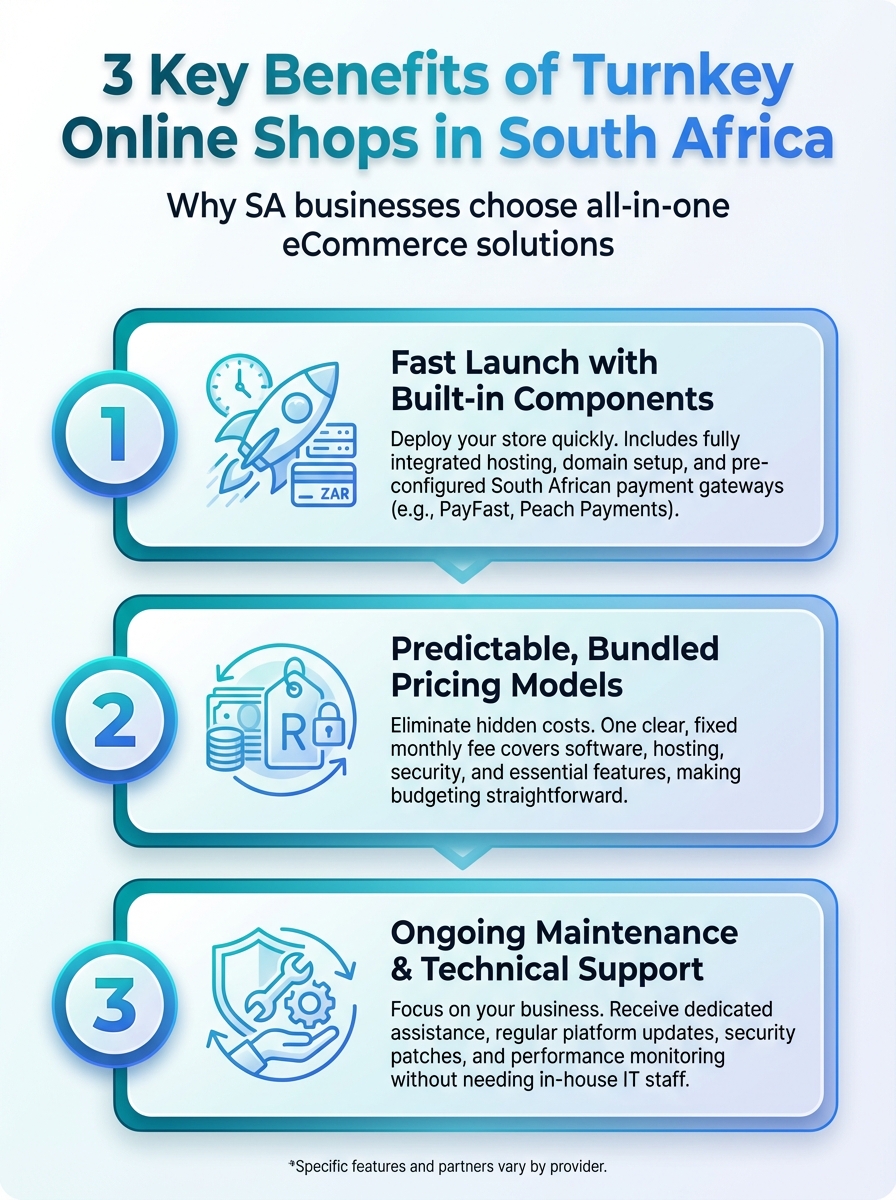
Explore three key benefits of turnkey online shops in South Africa and learn how they simplify launching an e-commerce business. From rapid setup to scalable operations, this infographic provides a quick, visual overview.
Did You Know?
Online retail turnover was R71 billion in 2023, up 29% from 2022 and accounting for about 6% of total retail in South Africa.
Source: World Wide Worx – Online Retail in South Africa 2024
4. Managed Hosting for Online Shops in South Africa: Advantages and Trade‑offs
Managed hosting is one of the most important choices you will make for your online shop in South Africa. Instead of renting generic hosting and managing everything yourself, you let specialists handle performance, security, backups, and updates.
Key benefits of managed hosting for local stores
Better performance for South African visitors through optimised infrastructure.
Ongoing monitoring, so issues are fixed before they become outages.
Regular updates to your platform, plugins, and security layers.
Support from a team that understands local payment gateways and logistics.
This is especially valuable if you do not have in-house technical staff and you want predictable monthly costs for hosting and support.
Possible drawbacks of managed hosting
Managed hosting typically costs more than very basic shared hosting. However, the real cost of downtime, hacks, or slow sites for an online shop is usually much higher than the small saving on cheaper hosting.
You also work within the technical environment that the managed provider sets up, so very unusual custom server setups might not be supported, although most eCommerce stores do not need that level of complexity.
5. Design, UX, and Mobile Experience: Pros and Cons for SA Online Shoppers
The design of your online shop directly affects how many visitors become paying customers. South African shoppers often browse and buy on mobile, so responsive, fast and clear layouts are not optional.
Pros of investing in professional design
Good UX and UI make products easy to find, carts simple to use, and checkout flows quick to complete. This increases your conversion rate, which means you earn more from the same traffic.
Professional design also builds trust, which is critical in South Africa, where some consumers are still careful about entering card details online.
Risks of poor design or DIY layouts
Slow, confusing, or cluttered stores lead to abandoned carts and frustrated customers. On mobile especially, small buttons or crowded text make it hard to complete a purchase.
Over time, a poorly designed store can cost you far more in lost sales than the saving you made by not working with a specialist team.
6. Payment Gateways for South African Online Shops: Benefits and Limitations
Payment gateways are the backbone of local online shops, since they handle card payments, instant EFT, and other methods. Choosing the right gateway affects your fees, customer experience, and even your risk profile.
Advantages of leading South African gateways
Solutions like PayFast, PayGate, iKhokha, Peach Payments, Yoco, VCS, SnapScan, and Adumo Online give your customers familiar payment options. Most of them offer card payments, instant EFT, and sometimes additional methods like QR codes.
These gateways also integrate well with WooCommerce stores, which is the platform we use for our client sites, so setup is efficient and reliable.
Potential drawbacks and risks
Each gateway has different fee structures, settlement times, and support levels. If you pick only one provider and they experience downtime, your store loses sales until the issue is resolved.
It is important to match your gateway choice to your customer base, product type, and risk appetite, instead of just picking the cheapest option advertised.
7. Real‑World Examples of South African Online Shops: What Works and What Does Not
We have built and supported more than 200 custom eCommerce websites across multiple industries in South Africa. Looking at real stores is a practical way to understand what works and where things can go wrong.
Pros illustrated by successful portfolio stores
Our portfolio includes electronics shops, fashion boutiques, wine stores, and specialist niche retailers. These stores benefit from custom design aligned to their brand, integrated payment gateways, and solid hosting.
They also use features like advanced product filters, customer accounts, and marketing integrations, which are difficult to implement correctly without experience.
Common pitfalls we see in underperforming stores
Poor product images, weak descriptions, and unclear pricing often hurt conversion rates. Slow loading times or unreliable hosting push shoppers to competitors who feel more professional.
Stores that neglect mobile layouts or fail to test their checkout process on common South African devices usually see unnecessary cart abandonment.
Did You Know?
Clothing (30%), groceries (22.3%), footwear (12.6%), electronics (12.5%), and medicines (11.7%) are the five most purchased online categories in South Africa.
Source: Mail & Guardian – Online shopping is booming in South Africa
8. Turnkey, Fully Managed Online Shops: Who Should Consider Them?
Not every South African business owner wants to deal with domains, plugins, security, and updates. That is why we built our turnkey, fully managed online shop service for clients who prefer a single partner handling everything.
Pros of turnkey managed online shops
Fast launch with a professionally designed, ready-to-sell store.
Hosting, security, backups, and software updates handled for you.
Local support that understands South African banks, couriers, and regulations.
Guidance on product setup, pricing, and everyday store operations.
This approach is ideal for entrepreneurs who want to focus on stock, suppliers, and customers, rather than learning technical web skills.
Possible limitations of fully managed setups
Some advanced users may feel constrained if they want to experiment constantly with technical configurations. However, for most businesses, the stability and support of a managed environment outweigh this concern.
We always discuss your growth plans upfront, so your managed store can scale with you without needing a costly rebuild later.
9. Ongoing Support and Maintenance: Pros and Cons for SA Online Stores
Launching your online shop is only the first step. Keeping it secure, fast, and up to date is an ongoing responsibility that many store owners underestimate at the beginning.
Benefits of continuous support
With our support and maintenance, you get help with product management, order handling, and technical tasks. This means you do not lose sales because of outdated plugins, broken layout elements, or misconfigured shipping rules.
Remote training also gives your team the confidence to manage day-to-day tasks, while we handle the complex back-end work.
Risks of neglecting maintenance
Unmaintained stores are at higher risk of hacking, data loss, and functionality issues. As online retail grows in South Africa, shoppers have more alternatives, so they quickly abandon sites that feel unreliable or unsafe.
Spending a little each month on structured maintenance is far less painful than paying to recover from a major failure or data breach.
10. Strategic Considerations: Choosing Platforms, Niches, and Growth Paths
When you plan an online shop in South Africa, it is not only about technology. Strategic choices around your niche, platform, and growth model will shape how successful your store becomes.
Pros of careful planning and niche selection
Choosing a focused niche and understanding your target audience increases your chance of standing out. It also guides your content, pricing, and product range, which makes your store feel coherent to visitors.
Using a robust platform like WooCommerce gives you flexibility to grow from a small catalogue to a more complex store without changing systems.
Common strategic mistakes to avoid
Starting with too broad a product range or copying big marketplaces usually leads to weak differentiation. Underestimating logistics, such as courier options and delivery pricing, also erodes profit margins.
We recommend mapping out your business model, logistics, and marketing plan before you go live, then using a managed, hosted store so you can adjust and grow with real data.
11. Future Outlook: How Online Shops in South Africa Are Expected to Evolve
Looking ahead, online retail in South Africa is expected to keep growing as a share of total retail. More shoppers are getting comfortable buying online, and categories like groceries, fashion, and electronics are leading the way.
Positive trends for local online shops
Improving payment options, better logistics networks, and wider smartphone use all support further growth. New tools for subscriptions, bookings, and recurring payments also open new business models for South African entrepreneurs.
At the same time, global players entering the market push local stores to raise their quality and service levels, which ultimately benefits customers.
Challenges that will remain
Competition will continue to intensify, both from large marketplaces and niche specialists. Load shedding and connectivity drops still affect operations in some areas, so resilient hosting and smart planning remain vital.
Store owners who invest in managed hosting, solid design, and long-term support will be better placed to compete in this evolving environment.
Conclusion
Online shops in South Africa offer powerful advantages, from lower startup costs and national reach to automation and flexible business models. At the same time, they bring real challenges around hosting, security, payments, logistics, and ongoing maintenance.
We have built our services around solving these challenges for South African businesses, by providing fully built, hosted, and managed online stores, along with expert support. If you want a professional online shop without the technical burden, a managed approach can give you a stable, scalable foundation to grow your eCommerce business in the South African market.
Launch your online shop today with a fully built, hosted, and managed eCommerce store – no technical headaches, just growth,
With over 21 years of experience, I specialise in designing and developing custom e-commerce websites and mobile apps for clients seeking to establish an online presence. I assist clients in building tailored e-commerce solutions and provide training on managing the backend, empowering them to run their online businesses independently.
Read more at
Linkedin