How to Sell on TikTok and Instagram in South Africa:
The New Social Commerce Gold Rush
Social commerce in South Africa is exploding, and TikTok is leading the charge, with 71% of local users discovering products on the platform and turning casual scrolling into real sales for fashion, beauty, and home brands. We see South African entrepreneurs, especially in townships and among Gen Z and Millennials, using TikTok Shop, shoppable videos, and live shopping events to move serious volume without huge budgets or big teams.
Key Takeaways selling on TikTok
| Question | Answer |
|---|
| How is TikTok Shop changing social commerce in South Africa? | TikTok SA shoppers show 2.1x higher intent for fashion and home goods than on other platforms, which makes it ideal for impulse purchases and social commerce growth. |
| Do I still need a website if I sell on TikTok and Instagram? | Yes. A WooCommerce store gives you control over branding, payments, and data, while social platforms act as powerful traffic and sales channels. You can see how we structure full online stores on our ecommerce website design page. |
| How do I sell directly on social media in SA? | You connect your product catalog to TikTok Shop or Meta Commerce Manager, then use shoppable videos, live shopping events, and product tags to drive instant purchases. Our guide to social commerce selling on social media explains this in more detail. |
| Can WooCommerce connect to TikTok Shop and Instagram Shopping? | Yes. You use a WooCommerce TikTok integration plugin and a Facebook / Meta catalog sync so that your store, TikTok Shop, and Instagram Shopping all share the same inventory and pricing. |
| Is social commerce really big in South Africa? | South Africa's social commerce market is projected to grow 35.2% in 2025 to around R28 billion, driven by mobile usage and platforms like TikTok and Instagram. |
| Where can I see the full picture of our e-commerce services? | You can explore our complete online store and social commerce-related pages through our Webs.co.za sitemap which lists all our core e-commerce resources. |
1. Why TikTok Shop Is Accelerating Social Commerce in South Africa
TikTok in South Africa is no longer just entertainment, it is a direct sales channel where browsing, discovery, and checkout blur into one experience. For fashion and home products, TikTok shows 2.1x higher shopper intent than other platforms, which is exactly why township brands, side-hustlers, and established retailers are investing in TikTok strategy right now.
From content to checkout in a few taps
With TikTok Shop, customers can buy without leaving the app, from a shoppable video, a product page, or a live stream. This short path from content to purchase is ideal for impulse buys, limited drops, and “TikTok made me buy it” trends that push GMV up quickly.
Why WooCommerce still matters in a TikTok-first world
Even if most of your traffic comes from TikTok South Africa and Instagram, the smartest strategy is to start with a properly built WooCommerce store. Platforms like Webs.co.za first design and set up your WooCommerce website as the central hub for your products, pricing, stock control, and branding - then sync it with TikTok, Instagram, and other social channels.
This approach delivers the best long-term results because your website becomes the single source of truth, while social platforms act as powerful sales and discovery channels. Inventory stays accurate, prices remain consistent, and your brand experience is controlled — no matter where customers discover your products.
By building first and syncing second, you avoid platform limitations, reduce errors, and create a scalable eCommerce setup that grows with your business.
We design stores so your social commerce channels link back cleanly into a solid e-commerce base, with fast hosting, local payment gateways, and a layout that supports ongoing campaigns and content, similar to the approach outlined on our ecommerce solution overview.
2. How Social Commerce Fits Into the South African E-commerce Landscape
South Africa’s social commerce market is projected to reach about R28 billion in 2025, growing over 35% in a single year. That growth is driven by mobile-first behaviour, WhatsApp sharing, TikTok trends, and Instagram Shopping, especially in fashion, beauty, home, and groceries.
Township and informal economy going digital
We see small sellers in townships using TikTok Shop and shoppable videos to sell clothing, cosmetics, food, and accessories without traditional retail overheads. Live shopping events hosted from a spaza shop, a home kitchen, or a backroom studio are already pulling solid daily GMV when the content is consistent and authentic.
Why your website and social channels must work together
Rather than choosing between “website” or “TikTok”, you should think in terms of one connected commerce system. We build WooCommerce stores that integrate with payment gateways like PayFast and Yoco and then plug that catalog into social platforms so your sales can happen anywhere your customer is watching.
3. How to Link WooCommerce to TikTok Shop Step by Step
If you already run a WooCommerce store, you do not want to upload products manually into TikTok Shop and risk mismatched stock or pricing. Instead, you use a WooCommerce TikTok integration plugin so your catalog, images, prices, and stock sync automatically between your store and your TikTok Shop.
Core steps for WooCommerce to TikTok Shop integration
Install a dedicated WooCommerce TikTok integration plugin from a trusted provider.
Connect your TikTok For Business account and TikTok Shop to the plugin.
Select which products and categories to sync from WooCommerce.
Map fields like title, price, stock, and images so TikTok uses your store data.
Test one or two products with a test shoppable video before rolling out everything.
Once this is set up, you can add products directly into TikTok videos, live streams, and your profile shop, while WooCommerce handles the actual order and fulfillment. We use similar thinking when we plan navigation and catalog structure for our clients, as shown in our ecommerce template layout guide, so that the same structure works across website, TikTok, and Meta Commerce Manager.
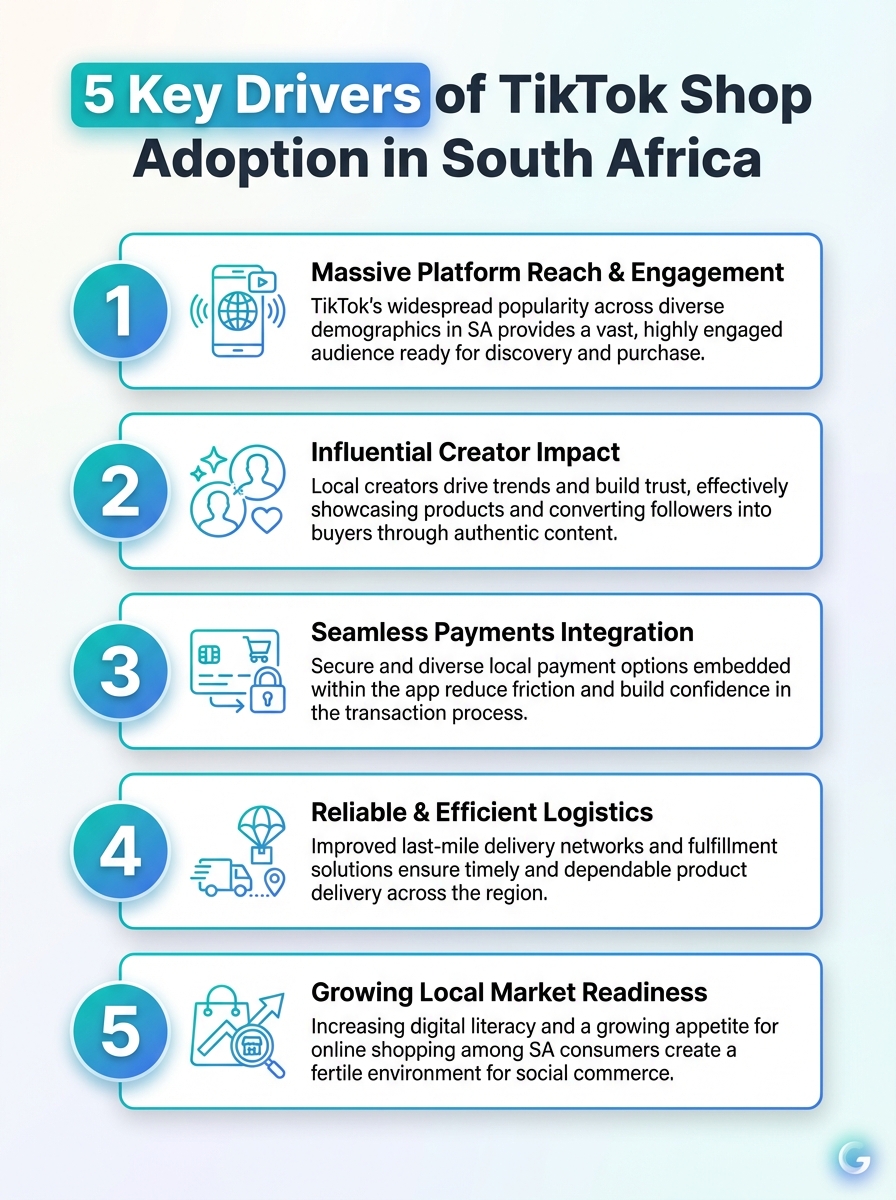
This infographic highlights five factors driving TikTok Shop adoption in South Africa. It also explains how social commerce is accelerating growth in the region.
4. Connecting WooCommerce to Instagram Shopping via Meta Commerce Manager
Instagram Shopping still plays a huge role, especially for fashion, beauty, and lifestyle brands targeting South African Gen Z and Millennials. To sell directly on Instagram and Facebook Shops, your WooCommerce catalog needs to sync with Meta Commerce Manager, so your product tags always show correct prices and stock.
How Meta Commerce Manager fits into your setup
In a typical setup your WooCommerce store is the source, Meta Commerce Manager manages your Facebook and Instagram catalogs, and TikTok Shop connects through its own plugin. This gives you three front doors (site, TikTok, Instagram) that all lead to the same inventory pile in WooCommerce.
Basic workflow for WooCommerce to Meta Commerce Manager sync
Install a WooCommerce to Facebook / Instagram integration plugin.
Connect your Facebook Business Manager and create a Commerce Manager catalog.
Sync WooCommerce products into the catalog on a schedule.
Enable product tagging on Instagram and Facebook Shops.
Once this is in place you can run parallel TikTok strategy and Meta strategy, both pushing traffic and orders into the same backend store.
Did You Know?
62% of South African TikTok users make immediate purchases after exposure to ads, which shows how short the journey from content to checkout has become.
Source: BusinessLive
5. Designing Your Store for Shoppable Videos and Social Traffic
When your main traffic sources are TikTok Shop, Instagram Reels, and live shopping events, your store design needs to respect how those visitors behave. Social visitors usually land on mobile, scan fast, and want to checkout in as few taps as possible, often right after watching a creator demo the product.
Key design features for social commerce traffic
Strong product pages with clear pricing, benefits, and social proof.
Fast mobile performance so TikTok viewers do not bounce while your page loads.
Simple checkout with local gateways like PayFast, Yoco, EFT, or PayPal.
Good category structure that matches your TikTok and Instagram content themes.
We focus heavily on navigation, branding, and user experience when building stores, which you can see reflected in our projects and articles inside the E-commerce web design category
6. Crafting a TikTok Strategy for SA: Content, Creators, and Catalog
Throwing random videos at TikTok rarely moves GMV in a meaningful way. You need a simple TikTok strategy tailored for South Africa that connects your content to specific products and makes it easy for viewers to buy on TikTok Shop or your WooCommerce store.
Content types that sell well on TikTok SA
Try-ons and hauls for fashion, streetwear, and beauty.
Before and after demos for homeware, cleaning, and DIY.
Recipes and “cook with me” for groceries and prepared meals.
Behind-the-scenes of township brands, local makers, and side hustles.
We see South African TikTok users spending 2x more on fashion and home goods than users on other platforms, so these categories especially benefit from a tight catalog, strong videos, and clear calls to buy.
7. Live Shopping Events: Turning Attention Into Instant GMV
Live shopping events are where TikTok Shop and Instagram really start to feel like a QVC-style channel in your pocket. A single well-planned live where you demo products, answer questions, and drop limited discounts can do a full week’s worth of normal daily GMV.
How to run effective live shopping streams
Prepare your product lineup and link them in the live interface before going live.
Use a clear structure: intro, product demos, Q&A, final call to action.
Offer limited-time discounts or bundles only available during the live.
Save the live as a replay and clip key moments into shoppable videos.
Because 61% of South African TikTok transactions happen outside of formal promotions, live shopping should not only be used for Black Friday or big campaigns, but as a regular part of your weekly sales rhythm.
Did You Know?
66% of TikTok users in South Africa influence friends and family to make purchases after seeing content, which means every good piece of content can ripple far beyond your follower count.
Source: BusinessLive
8. Multi-vendor Marketplaces, Dropshipping, and Social Commerce in SA
Social commerce is not just for single-brand stores. Multi-vendor marketplaces and dropshipping operations in South Africa are also tapping into TikTok Shop and shoppable content to scale faster without massive inventory risk.
Multi-vendor platforms with social hooks
A multi-vendor WooCommerce marketplace lets many sellers share one storefront, which is especially useful if you want to aggregate township brands, local food sellers, or niche makers under one roof. From there, you can run a central TikTok and Instagram presence that pushes traffic to different vendors, similar in spirit to what we describe on our multi-vendor marketplace page.
Dropshipping + TikTok Shop in South Africa
Dropshipping in South Africa pairs well with TikTok because you can test products through content before committing to stock. When a product goes viral in shoppable videos, you can route orders directly to suppliers, as discussed on our dropshipping in South Africa guide.
9. Tech, Hosting, and Security Behind High-growth Social Commerce Stores
When TikTok SA or Instagram suddenly sends a traffic spike, slow hosting and weak infrastructure can kill your momentum. We prefer building on stable WooCommerce setups with managed hosting, regular updates, and local infrastructure that can handle viral moments.
What your tech stack should cover
Reliable hosting in a quality data centre for low latency.
Automatic backups and updates to keep your site secure.
Payment gateway integrations that support card, wallet, and EFT payments.
Shipping integrations with South African couriers that work with your fulfillment model.
Our approach to custom e-commerce website development is built around these fundamentals, so we can then layer TikTok Shop, Meta Commerce Manager, and other social commerce tools on top, as described on our custom eCommerce development page.
10. Pricing, Budgeting, and Getting Professional Help
Many South African businesses hesitate to move into TikTok Shop and Instagram Shopping because they assume the setup is complex or too expensive. In reality, the main costs are your WooCommerce build, your hosting, and some integration and content time, which is far less than opening a physical store.
Where your budget usually goes
Store build and design, sometimes using templates, sometimes custom.
Managed hosting and maintenance to keep the store fast and secure.
WooCommerce TikTok integration plugin and Meta Commerce Manager sync tools.
Content production for shoppable videos, lives, and product photos.
We guide clients through realistic pricing and package options on our ecommerce web design price page, then help them plan how to scale with TikTok and Instagram as their sales grow.
11. Practical Roadmap: From Zero to Social Commerce in South Africa
If you are starting from scratch, it helps to follow a simple, practical roadmap. The goal is not perfection on day one, it is to get a clean WooCommerce base live and then plug TikTok, Instagram, and live shopping into it step by step.
Recommended rollout plan
Launch a basic WooCommerce store with your core products.
Set up payment gateways and shipping for South Africa.
Install a WooCommerce TikTok integration plugin and connect TikTok Shop.
Connect WooCommerce to Meta Commerce Manager for IG and Facebook.
Start posting shoppable videos and run your first small live shopping event.
Review your data weekly and refine your TikTok strategy and content themes.
If you want help planning or implementing this, you can browse some of our recent client work in our portfolio showcase and then reach out when you are ready.
Conclusion
If you have a product that people love and you are ready to sell directly on TikTok and Instagram, we can help you build the kind of store and integration setup that lets you focus on content and customers while the online store quietly does its job.
We’ll build your WooCommerce store first, then connect it seamlessly to TikTok Shop, Meta Commerce Manager, and shoppable videos.
👉 Start selling smarter with a store built for social commerce.
With over 21 years of experience, I specialise in designing and developing custom e-commerce websites and mobile apps for clients seeking to establish an online presence. I assist clients in building tailored e-commerce solutions and provide training on managing the backend, empowering them to run their online businesses independently.
Read more at
Linkedin