Online Shops in South Africa: Winning in Fashion, Electronics & More Niche Markets
Last updated: February 2026
Online shops in South Africa are entering a decisive growth phase, with online retail already projected to exceed R130 billion and about 10% of total retail by the end of 2025, which means local businesses that move online now can capture a rapidly expanding market. We see this every day as more fashion labels, electronics sellers, grocery services, and niche brands use professional eCommerce platforms to sell across the country and into global markets.
Takealot remains South Africa's dominant online retailer in 2026, far surpassing its 2016 position with strong revenue growth and massive web traffic. Recent reports confirm explosive e-commerce expansion, driven by local platforms amid international competition.
Market Growth
Online retail sales hit R96 billion in 2024 (up 35% year-over-year) and are projected to exceed R130 billion in 2025, capturing about 10% of total retail. Growth accelerated to 38% annualized in 2025, outpacing physical retail's 1.6-2.5%, fueled by mobile shopping, quick delivery, and secure payments. Takealot Group's FY26 half-year revenue jumped 23% to mid-2025, with takealot.com alone up 20% and serving 4.8 million active shoppers. aftership
Takealot leads decisively, used by 31.9% of shoppers in 2024 (up from 20.9% in 2023) and 45% as a primary destination. International entrants like Shein/Temu (15.3%) and Amazon (12.3%) gained ground but trail locals. itweb.co
Key Trends
Grocery and on-demand delivery surged, with Checkers Sixty60, Pick n Pay (8%), and Woolworths (7%) prominent; Woolworths saw 50% online grocery growth. WooCommerce powers 46% of 176,400 active stores, ahead of Shopify (30%). Challenges include tighter customs for cheap imports, boosting local adaptation. lula.co
Takealot's Edge
Wide product range, logistics investments, and 12,000+ marketplace sellers sustain dominance despite Amazon's 2024 entry. Traffic metrics show 5.07 pages/visit and low 49.54% bounce rate, indicating strong engagement. reuters
Key Takeaways
Question | Short Answer |
|---|
How fast are online shops in South Africa growing? | Online retail is growing at annualised rates of about 38%, with strong momentum into 2025, which creates real opportunity for new online stores. |
What do you need to start an online shop in South Africa? | You need a professional eCommerce website, reliable hosting, payment gateway integration, and a clear launch plan. Our guide on how to start an online shop covers these steps in detail. |
Which industries benefit most from online stores? | Fashion, electronics, groceries, online education, and other niche product markets are all growing online, with fashion and daily-use items seeing particularly strong demand. |
What does a basic professional online shop cost? | Our Basic Online Shop starts at R399 per month for up to 30 products, including hosting, domain, and setup, which makes it accessible for small businesses. |
How are payments handled in South African online shops? | Most stores use local payment gateways and card processing, and many also integrate PayPal. Our PayPal-based store setup is one option for reaching international buyers. |
Can a small business realistically sell nationwide? | Yes, with a fully managed store and courier integration, even micro businesses can offer national delivery. Our turnkey eCommerce solution is built specifically to make this simple. |
1. The State Of Online Shops In South Africa In 2024–2025
Online shops in South Africa have moved from experimental side-projects to core revenue channels for retailers of all sizes. Online retail already accounts for around 8% of total South African retail and is expected to pass 10% by 2025, which shows that local consumers have embraced buying online across many categories. We see a clear shift in buyer expectations. Shoppers expect professional design, quick loading times, transparent delivery options, and familiar local payment methods. For retailers, this means treating an online shop as a full retail outlet, not a simple catalogue. This is why we focus strongly on complete solutions that combine design, hosting, payments, and support in one managed package.
2. Local Online Buying Trends: Who Is Shopping And What Are They Buying?
South African online shoppers are no longer limited to early adopters or tech enthusiasts. The 25 to 34 age group represents about 40% of online shoppers, while 45 to 64 year olds account for roughly 34%, which proves that online buying has gone mainstream across age groups. Shoppers use online shops in South Africa for both essential and discretionary spending. Clothing, shoes, accessories, electronics, groceries, and digital products all show strong growth, with fashion and everyday items leading the pack. We also see a rise in specialised and niche stores. Local brands target tightly defined audiences, such as streetwear lovers, eco-conscious buyers, or regional food products, and use professional online stores to speak directly to these segments.
3. Fashion And Apparel: The Fastest-Growing Online Category
Why South Africans Love Buying Clothing Online
Fashion is one of the strongest drivers of online shops in South Africa. Shoppers appreciate wide size ranges, frequent new drops, easy comparisons, and the ability to browse multiple local brands without leaving home. Our clothing store clients typically see quick adoption when they combine strong visuals with clear sizing and returns information. They use lifestyle photography, bold branding, and easy checkout flows to earn trust and repeat orders.
Launching A South African Online Clothing Store
If you plan to launch an online clothing shop, you need more than product photos. You must define your niche, structure your categories logically, write accurate descriptions, and ensure your store looks professional on mobile devices. This is why we provide practical guidance on selecting a niche, setting prices, and planning inventory for new fashion entrepreneurs. We cover these topics in detail in our clothing store resources and help business owners avoid common mistakes like overstocking slow-moving SKUs or underestimating courier costs.
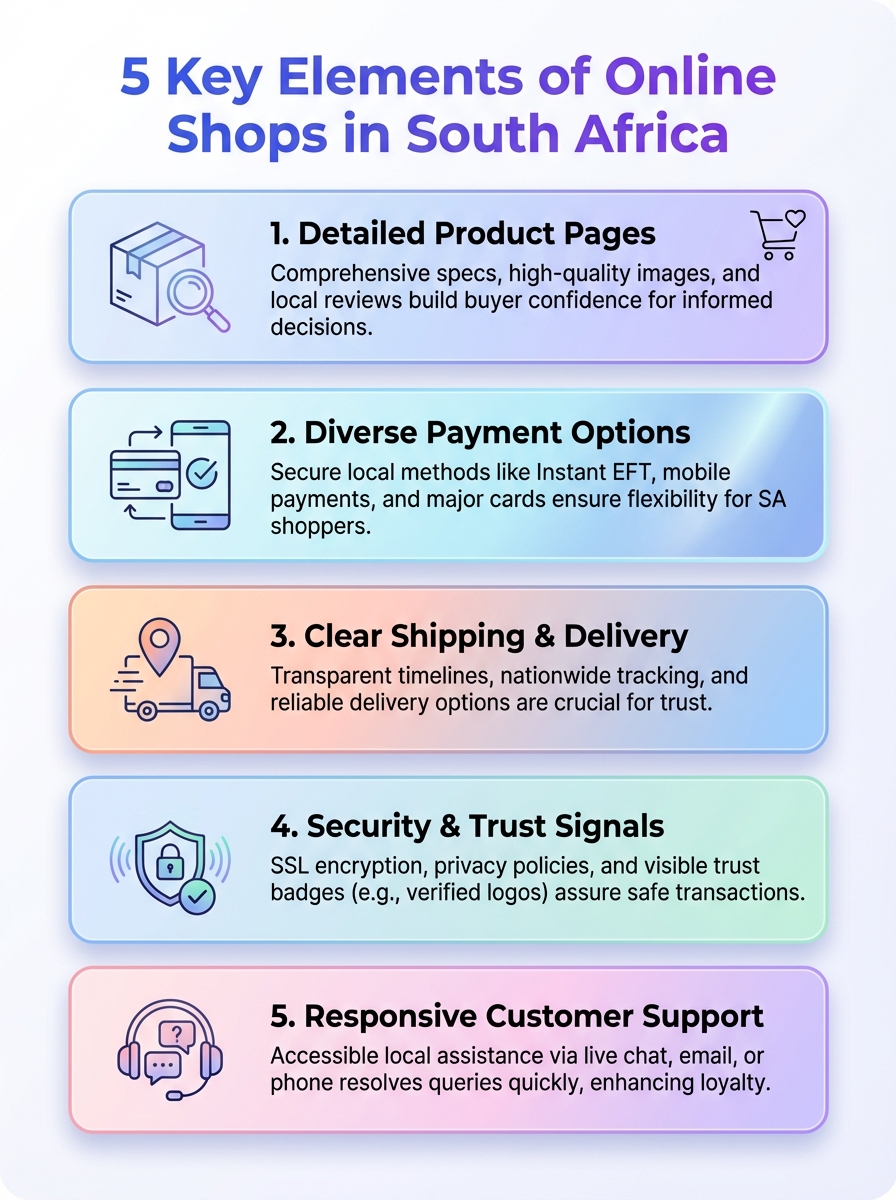
This infographic highlights the five core elements of Online Shops in South Africa. It helps readers understand how local e-commerce platforms attract and serve customers.
4. Electronics, Groceries, And Everyday Essentials Online
Electronics and tech products are natural fits for online shops in South Africa. Customers like clear specifications, comparisons, and the ability to read reviews before purchasing, which shifts more of this category online each year. Grocery and household delivery has also surged. On-demand platforms proved that South Africans are comfortable buying food and daily-use items online, and now many independent grocery outlets and specialty food stores are building their own online shops. For smaller grocery, electronics, or homeware retailers, this is an opportunity to own the customer relationship. Instead of relying only on big marketplaces, they run branded online stores where they control pricing, merchandising, and communication.
Did You Know?
Mobile devices were responsible for roughly 50.4% of online purchases in South Africa in 2024, which means more than half of local eCommerce happens on phones.
Source: Mail & Guardian
5. Niche Markets And Digital Products: From Courses To Specialist Stores
Online Education And Course-Based Businesses
Digital products and online education are an important part of online shops in South Africa. Course creators, consultants, and training providers sell access to video classes, memberships, and learning materials through dedicated eCommerce sites. An online education business works like any other online shop, but the product is digital. Instead of shipping a parcel, the store delivers secure course access, downloads, or membership features after payment.
Specialist And Hobby Niches
We also see strong demand in niche segments such as craft supplies, local art, regional foods, sporting gear, and collectibles. These markets are often too specialised for broad marketplaces, so a focused online shop with clear branding and strong information becomes a key competitive edge. Successful niche stores usually start small and then scale nationally. They use managed eCommerce solutions so the owners can focus on sourcing, content, and customer service rather than technical maintenance.
6. How South Africans Prefer To Pay In Online Shops
Payment habits are central to how online shops in South Africa succeed. Local shoppers are familiar with card payments, instant EFT, and digital wallets, and they expect an online store to offer multiple secure options. A large percentage of cart abandonment is linked to payment issues, especially declined cards. This means reliable payment gateways, clear error messages, and simple checkout steps are not small details, they are direct revenue drivers. We integrate South African payment gateways and services that support cards, instant EFT, and subscription models. For stores targeting international customers or freelancers selling digital products, we also offer a dedicated setup for PayPal-based online shops.
Payment Method | Typical Use In SA Online Shops | Key Benefit |
|---|
Credit / Debit Cards | Standard for most retail stores | Familiar and fast checkout |
Instant EFT | Popular with bank-centric shoppers | No card required, real-time confirmation |
PayPal | Useful for international buyers | Global brand trust and multi-currency |
7. Delivery Expectations And Courier Choices For SA Online Stores
Delivery is a key part of how customers judge online shops in South Africa. Shoppers compare delivery speed, reliability, tracking, and packaging quality, and many will choose a store based on courier performance as much as price. Most customers expect clear delivery options at checkout. They want to see courier costs, estimated delivery times, and any free-shipping thresholds before paying, not as a surprise afterward. We work with South African courier and last-mile providers to integrate shipping options into our online store builds. This includes setting up rules for national, regional, and local deliveries and giving store owners the tools to update rates as needed.
Reliable delivery and clear tracking are now as important to South African online shoppers as product choice and pricing.
8. How Small Businesses Use Online Shops To Scale Nationally
Online shops in South Africa are a powerful leveller for small and medium businesses. A micro retailer that once sold only in a local market or single suburb can now reach customers in every province with the same website. Our fully built, hosted, and managed online stores are designed specifically for this kind of growth. We handle the technical stack, security, and updates, while the business focuses on products, content, and customer relationships. Below is a simple view of how a managed solution helps a small business scale.
Stage | Traditional Retail | With A Managed Online Shop |
|---|
Launch | High setup costs and lease commitments | Affordable monthly package, no physical lease |
Reach | Limited to foot traffic in one area | National reach with courier networks |
Scaling | New branches required for growth | Same store infrastructure handles higher order volumes |
Our Basic Online Shop package, for example, starts at R399 per month for up to 30 products and includes hosting, a domain for one year, product upload, and price setup. This kind of predictable cost structure helps small businesses plan and grow without needing in-house developers or large upfront budgets.
Did You Know?
Around 73.9% of South African retailers say that customer service is the single most important factor for online retail success.
Source: Mail & Guardian
9. User Experience, Design, And Mobile-First Online Shops
Good design is not cosmetic for online shops in South Africa, it directly affects sales. Clear navigation, consistent branding, easy-to-read copy, high-quality product photos, and a frictionless checkout all increase conversion rates. We design stores with mobile usage in mind, because more than half of local online purchases now happen on phones. This means touch-friendly menus, fast-loading pages, responsive layouts, and concise checkout forms in as few steps as possible. Our eCommerce website design approach also pays attention to trust signals. We add clear contact details, policy pages, security badges, and professional layouts so new customers feel comfortable buying from a South African store they have not used before.
10. Service, Support, And Managed eCommerce For South African Merchants
Running an online shop in South Africa involves ongoing work, not a once-off build. Product ranges need updates, prices change, courier agreements shift, and technology evolves, which is why long-term service and support matter. We provide full remote training to help store owners manage their catalogues, process orders, and understand reports. Our clients learn how to add new products, change prices, and manage stock without needing to call a developer for every change. We also handle the technical side, including hosting, security, updates, and troubleshooting. This gives South African businesses a reliable foundation to grow while we manage the complex background tasks that keep an online shop stable.
11. Practical Steps To Start Selling Online In South Africa
If you want to join the growth of online shops in South Africa, you do not need to handle everything alone. A structured launch plan and a fully managed store can shorten your timeline from idea to first sale. Typical steps include choosing a niche, defining your products, and deciding how you will handle stock and delivery. Then you choose a suitable package, such as our R399 per month Basic Online Shop for up to 30 products, which already includes hosting and domain registration for the first year. From there, we handle the build and integrations while you prepare product information. We design your store, connect payment gateways, configure shipping, and provide training so that you can confidently run your new online business across fashion, electronics, groceries, or any niche you choose.
Conclusion
Online shops in South Africa are expanding rapidly across fashion, electronics, groceries, online education, and many niche markets, driven by growing consumer trust and better infrastructure. With clear buying trends, strong mobile usage, evolving payment options, and reliable courier networks, small and medium businesses can now sell professionally across the country and beyond, especially when they use fully built, hosted, and managed online stores like those we provide at Webs.co.za to launch, run, and grow without technical hassle.
Start your online store today with Webs.co.za – fully built, hosted, and managed for your success!
With over 21 years of experience, I specialise in designing and developing custom e-commerce websites and mobile apps for clients seeking to establish an online presence. I assist clients in building tailored e-commerce solutions and provide training on managing the backend, empowering them to run their online businesses independently.
Read more at
Linkedin