Profitable Drop Servicing Business Ideas for 2026
Imagine running a successful service business without needing to learn web design, video editing, or SEO yourself. In 2025, business owners are discovering Profitable Drop Servicing Business Ideas that let them sell valuable services while hiring skilled freelancers to do the actual work - and keeping the profit in between. This smart business model is changing how startups and entrepreneurs run service-based businesses. It offers a low-risk way to enter the digital economy with profit margins that often beat traditional e-commerce models.
Drop servicing, also called service arbitrage or white labeling, is a powerful opportunity for people who want to build income streams without huge upfront costs or special technical skills. As the gig economy keeps growing and remote work becomes normal, the tools for successful drop servicing have never been easier to access.
Key Takeaways
- 💼 Drop servicing is a business model where you sell services to clients and hire freelancers to do the work, managing the project and keeping the profit margin (usually 30-70%)
- 📈 Profit margins in drop servicing are much higher than dropshipping (30-70% vs. 10-30%), making it one of the most profitable online business models in 2025
- 🚀 Low startup costs let entrepreneurs begin with almost no budget by using free marketing platforms and only paying freelancers after getting paid by clients
- 🎯 Popular services like web design, SEO, video editing, and AI-assisted content creation offer the best profit opportunities for drop servicing businesses
- ⚖️ Legal and ethical when done honestly, drop servicing works like traditional agencies that coordinate specialized work across teams
Understanding the Drop Servicing Business Model

Drop servicing is a business model where an entrepreneur sells digital services to clients while hiring freelancers, agencies, or contractors to actually do the work [1]. Acting as the middleman, the drop servicer manages client relationships, coordinates projects, checks quality, and keeps the profit margin between what they charge clients and what they pay service providers.
Unlike traditional service businesses that need to build an in-house team with special skills, drop servicing lets business owners offer many professional services without having all the technical skills themselves. The entrepreneur focuses on getting clients, managing projects, and checking quality while using the global talent pool available through platforms like Upwork, Fiverr, and Freelancer.
How Drop Servicing Works: The Complete Workflow
The drop servicing process follows a simple workflow that can be organized for growth:
- Define Service Packages - Create clear service offerings with specific deliverables and pricing
- Accept Client Orders - Market your services and get client commitments with deposits or full payment
- Hire Vetted Providers - Give the work to pre-screened freelancers at a lower cost than your client price
- Review for Quality - Check completed work to make sure it meets client needs and quality standards
- Deliver Final Product - Give the finished service to your client with professional communication
- Keep the Profit Margin - Keep the difference between what you charged and what you paid the freelancer
"Drop servicing lets entrepreneurs sell skills they don't personally have by connecting clients with skilled professionals, creating value through coordination and quality management."
This workflow needs active management rather than passive income. Successful drop servicers spend time on client communication, handling revision requests, managing freelancer relationships, and keeping service quality high [2].
Profitable Drop Servicing Business Ideas for 2026
The most successful drop servicing businesses focus on services that clients need regularly and that can be reliably outsourced. Here are the top Profitable Drop Servicing Business Ideas leading the market in 2026:
Digital Marketing Services
SEO Optimization
Client Price:
R800-2,500/month
Outsourcing:
R300-1,000/month
Profit Margin:
50-60%
Social Media Management
Client Price:
R600-2,000/month
Outsourcing:
R250-800/month
Profit Margin:
55-65%
Content Marketing
Client Price:
R1,000-3,500/month
Outsourcing:
R400-1,500/month
Profit Margin:
50-60%
Email Marketing Campaigns
Client Price:
R500-1,500/project
Outsourcing:
R200-600/project
Profit Margin:
55-65%
Creative & Design Services
- Web Design & Development - High-value service with strong demand from small businesses and startups (learn more about affordable ecommerce website development)
- Logo Design & Branding - Quick turnaround projects with excellent profit margins
- Graphic Design - Ongoing need for marketing materials, social media graphics, and promotional content
- Video Editing - Fast-growing area, especially for YouTube creators and businesses creating video content
- Animation Services - High-value offering for explainer videos and marketing content
Content Creation Services
Copywriting remains one of the most profitable drop servicing opportunities, with businesses constantly needing website copy, sales pages, email sequences, and advertising content. The rise of AI tools in 2026 has actually increased demand for human-edited, strategically crafted copy that converts [3].
AI-Assisted Services represent the fastest-growing part of drop servicing in 2025. Services like AI-powered content repurposing, short-form video editing using AI tools, and AI-enhanced graphic design let drop servicers offer competitive pricing while keeping healthy margins by using technology alongside skilled freelancers.
Technical Services
- 🔧 WordPress Maintenance - Regular income from ongoing website updates and security
- 💻 App Development - High-ticket service for businesses needing custom solutions
- 🛡️ Cybersecurity Consulting - Growing demand as businesses focus on data protection
- 📊 Data Analysis & Reporting - Valuable for businesses making data-driven decisions
Drop Servicing vs. Dropshipping vs. Traditional Agencies

Understanding how drop servicing compares to similar business models helps entrepreneurs make smart decisions about which path to follow.
Drop Servicing vs. Dropshipping
While both models involve acting as a middleman, the key difference is what's being sold. Dropshipping focuses on physical products, requiring inventory management (even if virtual), shipping coordination, and dealing with product quality issues and returns. Profit margins typically range from 10-30% [4]. Learn more about starting an ecommerce business in South Africa.
Drop servicing sells digital services, removing physical inventory, shipping logistics, and product defects. Profit margins typically range from 30-70%, much higher than dropshipping. Also, service-based businesses often have higher perceived value and allow for better client relationships and regular income opportunities.
Drop Servicing vs. Traditional Agencies
Traditional agencies hire in-house teams with special skills, requiring big overhead costs including salaries, benefits, office space, and equipment. They keep full control over service delivery but need a lot of capital and time to build capabilities.
Drop servicing businesses work with minimal overhead by hiring freelancers on a project-by-project basis. This flexibility allows for:
- ✅ Lower startup costs - No need to hire full-time employees at first
- ✅ Easy to grow - Easily expand service offerings without hiring
- ✅ Less risk - Pay freelancers only when you have client work
- ✅ Faster launch - Start selling services right away without building a team
However, drop servicing requires careful quality control and freelancer management to keep consistent service standards, whereas agencies have direct oversight of their team members.
Starting Your Drop Servicing Business: Essential Steps
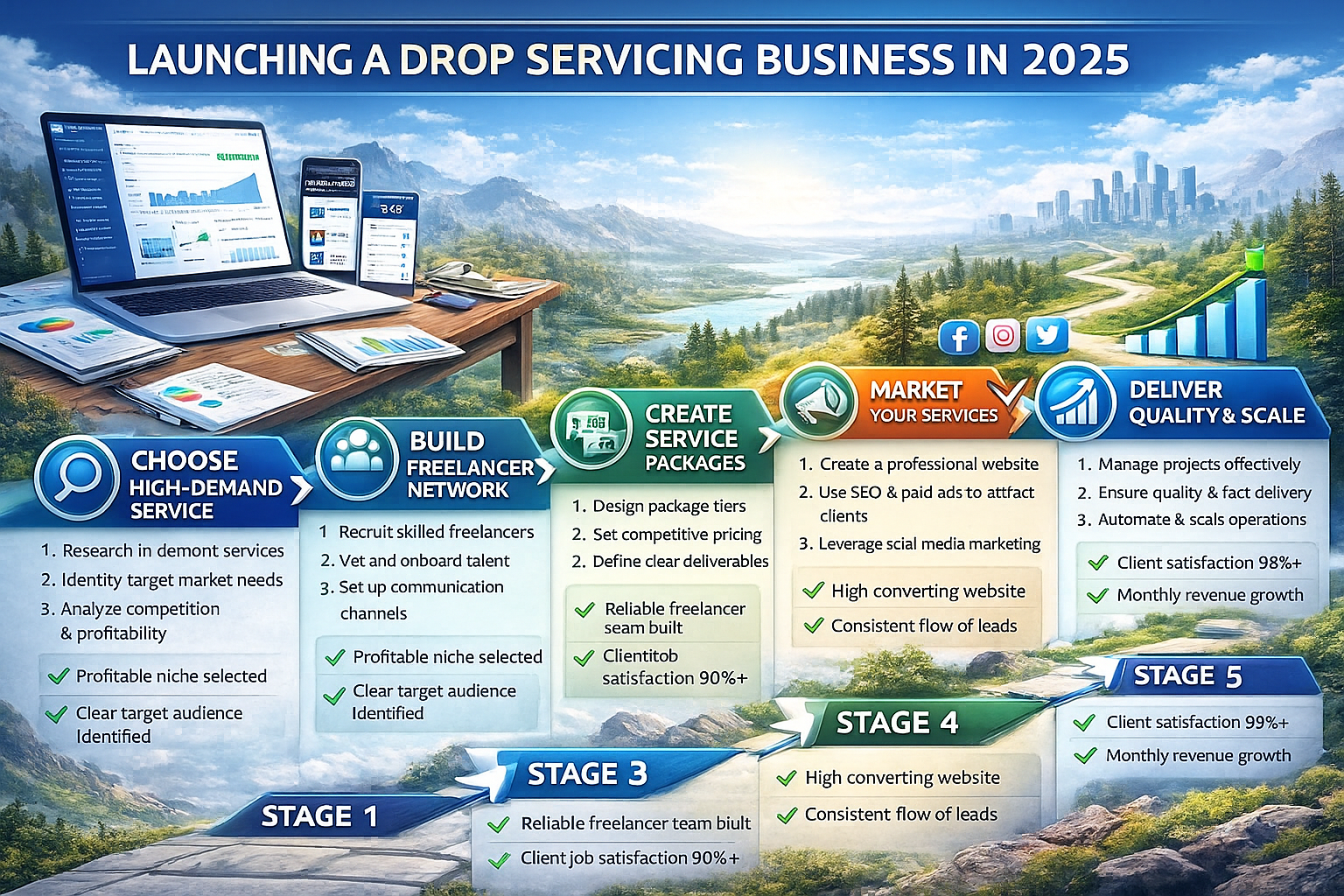
Launching a successful drop servicing business in 2025 requires smart planning and action across several key areas.
1. Select High-Demand Services
Research market demand using tools like Google Trends, freelancer marketplace data, and business forums to find services with strong, consistent demand. Focus on services where you can clearly explain value to potential clients and where quality can be objectively measured.
Profitable Drop Servicing Business Ideas should match your ability to market them effectively and your interest in managing those types of projects. Starting with 1-3 core services lets you build expertise and improve your processes before expanding. Consider services related to ecommerce which continues to grow.
2. Build a Reliable Freelancer Network
Your business quality depends entirely on your freelancer partnerships. Spend time on:
- 🔍 Checking freelancers carefully - Review portfolios, do test projects, check references
- 💬 Setting up clear communication - Set expectations for turnaround times, revision policies, and quality standards
- 🤝 Building ongoing relationships - Create a stable group of reliable providers for consistent quality
- 📋 Having backup options - Have multiple freelancers for each service to prevent bottlenecks
Platforms like Upwork, Fiverr, Freelancer, and specialized networks give access to global talent across almost every service category [5].
3. Create Compelling Service Packages
Package your services with clear deliverables, timelines, and pricing tiers. Good packaging might include:
- Basic Package - Essential service at an affordable price point
- Standard Package - Most popular option with extra features
- Premium Package - Complete solution with fastest turnaround and extras
Clear packaging makes the buying decision easier for clients and standardizes your operations for easier growth.
4. Develop Your Marketing Strategy
Getting clients is crucial for drop servicing success. Effective 2025 marketing channels include:
- Social Media Marketing - LinkedIn for B2B services, Instagram for creative services
- Content Marketing - Blog posts and videos showing expertise
- Cold Outreach - Personalized emails to businesses that need your services
- Paid Advertising - Google Ads and social media ads for faster client acquisition
- Referral Programs - Reward existing clients to recommend your services
Starting with free marketing channels lets you test your business model before spending on paid advertising. Learn from South African e-commerce success stories.
5. Establish Quality Control Processes
Put in place systematic quality checks to ensure client satisfaction:
- Review all freelancer work before client delivery
- Use checklists specific to each service type
- Request revisions from freelancers when needed (build this into your freelancer agreements)
- Gather client feedback and continuously improve
- Document common issues and solutions for training purposes
Quality consistency builds reputation and generates referrals, which become your most valuable marketing channel over time.
Legal and Ethical Considerations

Drop servicing is a completely legal business model when done honestly and ethically [6]. It works like how traditional agencies operate - coordinating specialized work across different team members or contractors.
Best Practices for Ethical Drop Servicing
- ✔️ Deliver promised quality - Make sure services meet or exceed client expectations
- ✔️ Keep communication open - Respond quickly to client questions and concerns
- ✔️ Honor timelines - Deliver work when promised or communicate delays early
- ✔️ Provide proper support - Offer revisions and address issues professionally
- ✔️ Protect client information - Make sure freelancers sign NDAs when handling sensitive data
You are not required to tell clients that you outsource work, just as traditional agencies don't detail which team members work on specific tasks. Your value comes from project management, quality assurance, client service, and delivering results - not necessarily in personally doing every task.
Overcoming Common Drop Servicing Challenges
While drop servicing offers great opportunities, entrepreneurs should prepare for common challenges:
Managing Client Expectations
Challenge: Clients may have unrealistic expectations about timelines or deliverables.
Solution: Create detailed service descriptions, use contracts that specify exactly what's included, and communicate actively throughout the project.
Freelancer Reliability Issues
Challenge: Freelancers may miss deadlines or deliver poor work.
Solution: Build a vetted network of backup freelancers, build buffer time into client deadlines, and set clear consequences for missed deadlines in freelancer agreements.
Maintaining Profit Margins
Challenge: Clients may request extra revisions or scope creep that reduces profitability.
Solution: Clearly define revision policies (e.g., "2 rounds of revisions included"), charge for extra work beyond scope, and negotiate revision limits with freelancers.
Scaling Operations
Challenge: Managing multiple projects at once becomes overwhelming.
Solution: Use project management tools (Trello, Asana, Monday.com), create standard operating procedures, and consider hiring a virtual assistant to handle administrative tasks as revenue grows. Consider automating your operations where possible.
The Future of Drop Servicing in 2026 and Beyond
The drop servicing industry continues to change with technology advances and changing market demands. Several trends are shaping Profitable Drop Servicing Business Ideas for the coming years:
AI Integration - Rather than replacing drop servicing, AI tools are improving it by letting freelancers work more efficiently, reducing costs while keeping quality. Services that combine AI capabilities with human creativity and strategy are getting premium prices.
Specialized Niches - Generic service offerings face more competition, while specialized services targeting specific industries (e.g., SEO for law firms, video editing for real estate agents) get higher prices and build stronger client loyalty.
Subscription Models - Monthly retainer arrangements provide predictable revenue and deeper client relationships compared to one-off project work. Services like ongoing social media management, monthly SEO optimization, and content creation work well for subscription packaging.
Remote Work Normalization - The continued acceptance of remote work expands the global freelancer talent pool, giving drop servicers access to skilled professionals across different time zones and cost structures.
Conclusion: Building Your Profitable Drop Servicing Business
Drop servicing represents one of the most accessible and potentially profitable business models for entrepreneurs in 2025. With low startup costs, operations that can grow easily, and profit margins much higher than traditional e-commerce models, it offers a great path for those willing to invest in client relationships and quality management.
Success in drop servicing doesn't require technical expertise in the services you sell - it requires business skills, project management abilities, and commitment to client satisfaction. By selecting popular services, building reliable freelancer networks, putting quality control processes in place, and consistently delivering value, entrepreneurs can build sustainable service businesses that generate good income.
Your Next Steps
Ready to launch your drop servicing business? Take these actionable steps today:
- Research and select 1-3 services with strong market demand that interest you
- Create sample packages with clear deliverables and pricing for each service
- Find and check 2-3 freelancers for each service on platforms like Upwork or Fiverr
- Set up your online presence with a simple website or social media profiles showing your services (explore affordable website options)
- Reach out to 10 potential clients through your network, cold outreach, or social media
- Deliver your first project with excellent quality to get your first testimonial and referral
The drop servicing opportunity is available to anyone willing to bridge the gap between clients needing services and freelancers capable of delivering them. Your role as coordinator, quality manager, and client advocate creates real value - and Profitable Drop Servicing Business Ideas await those ready to take action. Contact us for more information
References
[1] Entrepreneur.com - "Understanding Service Arbitrage Business Models" (2024)
[2] Forbes - "The Rise of Service-Based Entrepreneurship" (2024)
[3] Content Marketing Institute - "AI's Impact on Content Services Industry" (2025)
[4] Shopify - "E-commerce Profit Margin Benchmarks" (2024)
[5] Upwork - "Global Freelance Market Report" (2025)
[6] Small Business Administration - "Legal Considerations for Service Businesses" (2024)
With over 21 years of experience, I specialise in designing and developing custom e-commerce websites and mobile apps for clients seeking to establish an online presence. I assist clients in building tailored e-commerce solutions and provide training on managing the backend, empowering them to run their online businesses independently.
Read more at
Linkedin