
South Africa's online retail market is growing at double-digit rates. But the conversion problem is structural,
not cyclical, and the data is consistent across every major source. If you run a WooCommerce store in South Africa,
the numbers below are your baseline.
The Market Is Growing. The Checkout Is Not Keeping Up.
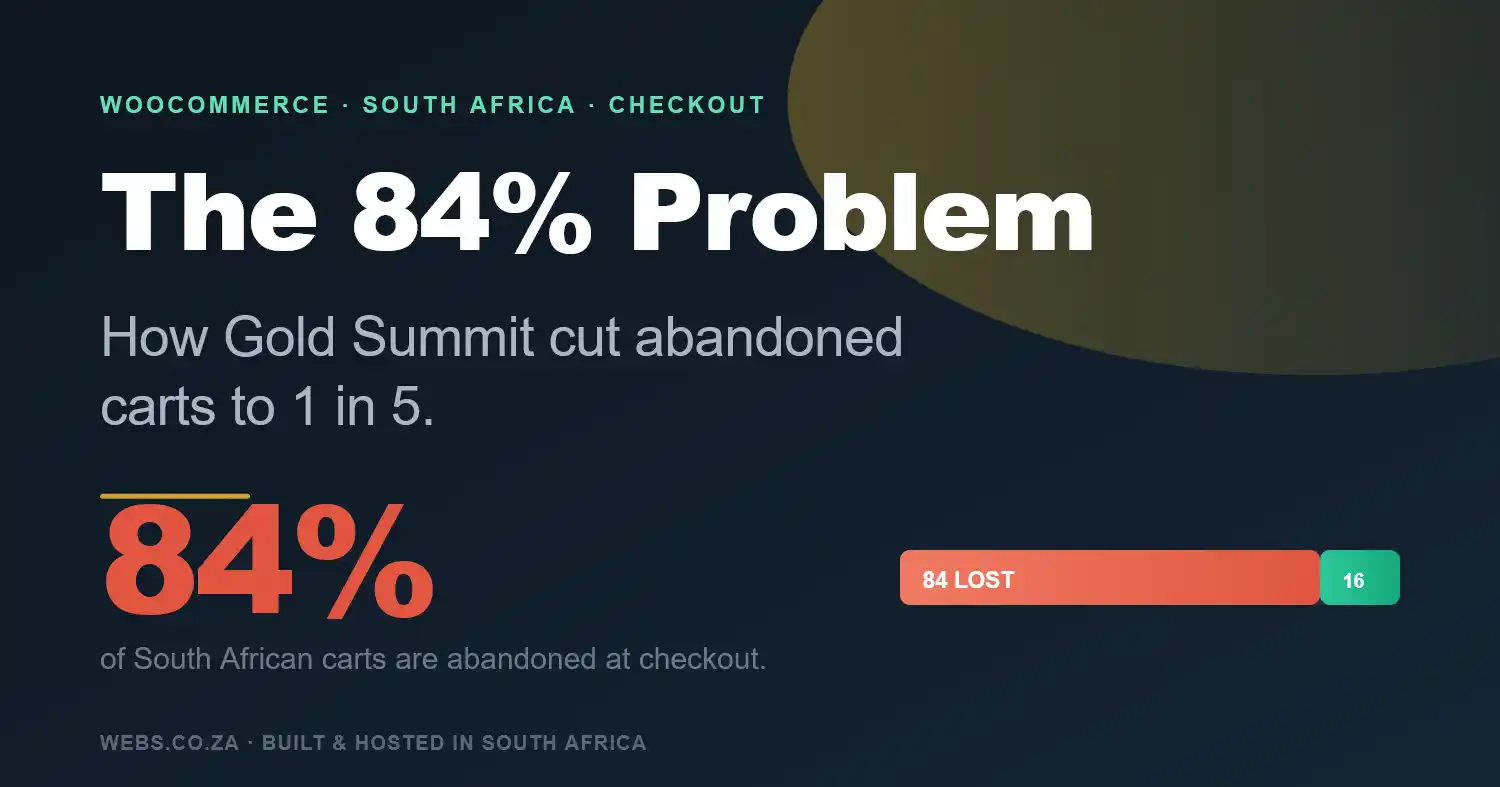
Cart abandonment in South Africa reached 84% in 2025, according to ECDB data cited in Stitch's
2026 Consumer Payments Report. For every 100 shoppers who add an item to a cart, only 16 complete the purchase.
The single largest driver is not shipping cost. It is payment failure. A Mastercard study found
that declined card transactions account for approximately 52.2% of lost online sales in South Africa.
And when a payment fails, the shopper does not simply retry later: 62% never return to complete the purchase at all.
Checkout Leak · South African Benchmark (2025)
Checkout leak · South African benchmark (2025)
Source: ECDB data cited in Stitch 2026 Consumer Payments Report.
The red section is the revenue lost. The green is what you keep.
Why They Leave—Ranked by Financial Impact
The payment failure number is the one that should stop you. It is not a marginal inconvenience. It is the majority
of your lost revenue.
Drivers of cart abandonment · South Africa
Payment failure: Mastercard study, cited via Stitch. Shipping, account, and speed drivers: FedEx E-Commerce Trends Report.
Why Payment Failure Is a South African Problem
Payment failure hits differently here because the recovery rate is so low. When a South African shopper hits a
failed transaction, 62% never return. The sale is not delayed. It is permanently lost.
online card payments in South Africa do not convert into a successful transaction. Most failures have nothing to do with fraud—they are insufficient funds, mistyped card numbers, expired cards, or abandoned 3D Secure steps.
Source: Stitch 2026 Consumer Payments Report.
South African shoppers have also developed precise fraud-detection instincts at checkout.
45% will not pay if they do not recognize the payment provider.
57% treat unexpected pop-ups or redirects as a fraud signal.
If your checkout sends a shopper to an unfamiliar gateway, you have already lost them.
The digital wallet advantage is measurable. When one South African enterprise retailer launched Apple Pay,
over 33% of iOS orders used it from day one, growing to 40% within two weeks. Apple Pay conversion exceeded 90%,
with 95% of transactions processed within five seconds. The speed and familiarity gap between card and wallet is
not cosmetic. It is conversion.
Gold Summit: What Happens When You Fix the Checkout
Case study · Gold Summit
A high-trust bullion dealer, sold online
Gold Summit sells gold bullion online—a category where buyer hesitation is extreme and credibility is everything.
Investment ads are difficult to place. Trust must be earned before the cart is ever loaded.
The problems
A high-trust category with a checkout flow that did not reflect that reality.
No live shipping visibility, so buyers could not verify when their purchase would arrive.
A generic landing page that did not address the specific hesitations of a bullion buyer.
What we changed
1. Live courier API with real-time tracking. This was the game-changer. Bullion buyers are not
impulse purchasers. They need to know exactly where their purchase is at every stage. Integrating a live courier
API with a visible tracking process removed the "where is my order?" anxiety that was killing conversions before payment.
2. A conversion-specific landing page. Not a homepage. A dedicated page built around the specific
questions a gold buyer asks before committing: authenticity, delivery security, tracking visibility, and payment safety.
The outcome was not a full rebuild. It was removing two specific trust blockages: delivery uncertainty and
landing-page mismatch. The national average is not inevitable. The stores that beat it are not spending more on ads.
They are removing the specific friction points their buyers actually care about.
What this proves: the 84% national average is not a law of nature. It is the result of a checkout
that has not been diagnosed.
The Three Leaks (And Which One to Fix First)
Payment path friction—fix this first
Payment failure accounts for the majority of lost sales. Add a digital wallet option (Apple Pay, Google Pay,
or Capitec Pay) alongside your existing gateway. Make the provider logo visible before any redirect. Reduce
the number of steps between "add to cart" and "payment complete."Delivery uncertainty
Gold Summit's experience shows that live tracking is not a logistics feature. It is a conversion feature.
Shoppers who cannot see where their order is will not complete the order. If you sell high-value or
high-anxiety products, visible shipping tracking is not optional.Landing page mismatch
A homepage tries to serve everyone. A conversion-specific landing page answers the exact questions a buyer
has before they commit. This is especially true for high-consideration categories where generic messaging
fails to address specific fears.
What This Means for Your WooCommerce Store
You do not need a R35,000 rebuild to close the 84% gap. Gold Summit did not rebuild from scratch. It fixed two
specific things: delivery trust and landing-page relevance.
The diagnostic sequence:
Check your payment success rate
If you do not know it, ask your gateway. If it is below 80%, the payment path is your first fix.
Add a digital wallet
Apple Pay, Google Pay, or a bank-native method. The conversion data is too strong to ignore.
Make shipping visibility a checkout feature
Not a tracking page buried in an email. A visible, real-time signal before purchase.
Build one landing page per high-value product or category
Answer the specific fears. Do not send paid traffic to a generic homepage.


