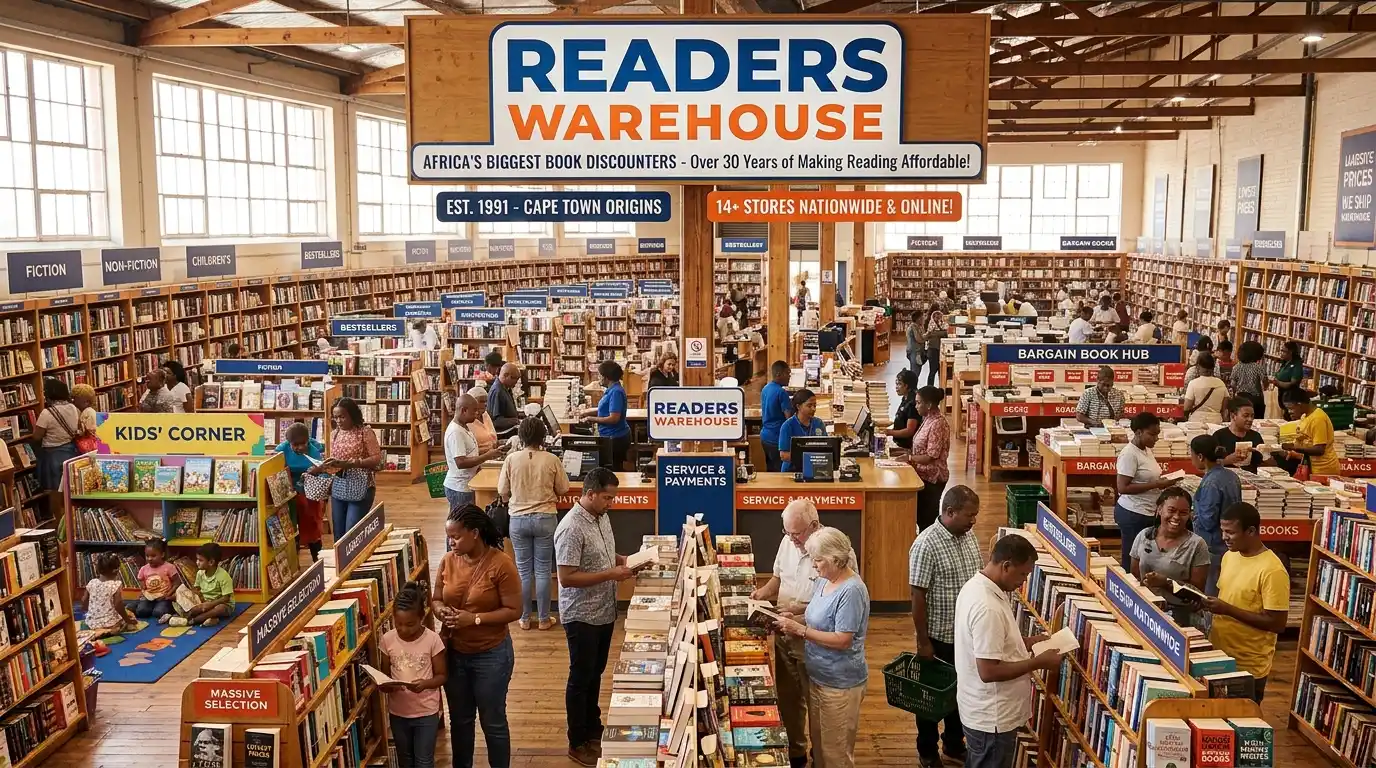
From Garage Sale to Retail Titan: The Readers Warehouse Story
How a South African family-owned bookseller’s commitment to affordable reading offers practical inspiration for first-time ecommerce entrepreneurs.
A good business does not always need a revolutionary product. Sometimes it needs a better answer to an ordinary problem.
How to Build a Scalable Online Store: Key Lessons for First-Time Founders:
Readers Warehouse's story proves a simple point: you don't need big capital to start a retail brand, you need a clear value proposition and the patience to scale it. From garage sales and flea markets to a multi-branch chain with a major online store, the business grew by staying relentlessly focused on one idea: books should be affordable. For first-time entrepreneurs, the real takeaway isn't the discount pricing model itself, it's the discipline to test small, stay niche, and build multiple sales channels (retail, online, and institutional) around that one core promise. Start small, prove demand, then expand deliberately.
For Readers Warehouse, that problem is easy to understand: people want books, but their budgets do not always stretch to the books they want.
A parent looking for bedtime stories. A teacher building a classroom library. A reader hoping to discover another favourite author without overspending. Different customers, one shared need: affordable access to reading.
According to its official About Us page, Readers Warehouse is a South African family-owned bookstore established by two brothers dedicated to making books accessible and affordable for everyone.
Today, its combination of physical stores, online shopping and school-focused services makes it a useful success story for anyone preparing to launch an ecommerce business.
Not because every startup should sell books. Because every startup needs a reason for customers to choose it.
Two Brothers, One Clear Promise
Readers Warehouse’s public story begins with a straightforward purpose rather than a complicated business pitch.
Make books more accessible. Make them more affordable.
The company identifies avid readers, families, students and educators as its customers. Its offering includes bestselling fiction, children’s books, picture books and educational titles.
That clarity matters.
A first-time entrepreneur can spend months choosing colours, comparing platforms and polishing a logo while leaving the most important question unanswered:
Why should someone buy from this business?
Readers Warehouse gives shoppers a clear answer: a broad choice of books at competitive prices.
Your answer may be different. Perhaps you offer specialist knowledge, locally made products, hard-to-find supplies or convenient bundles for a particular customer. Whatever it is, customers should understand it without needing a presentation.
Before getting lost in the technical details, work through the essentials of starting an online shop: who you serve, what they need and why your offer deserves their attention.
A website gives your business a place to trade. A clear value proposition gives people a reason to visit.
The Real Lesson Is Not “Sell Everything Cheaper”
It would be easy to look at a discount bookseller and conclude that success comes from cutting prices.
That is an incomplete lesson, and a dangerous one for a new business.
The sources reviewed confirm Readers Warehouse’s discount positioning, but they do not establish its profit margins, inventory turnover or the proportion of stock sourced through publisher overruns and remainders. Those details should not be invented to make the story more dramatic.
For a startup, the useful question is not simply, “How low can I price this?”
It is, “Can I deliver this value repeatedly while covering the full cost of the sale?”
That means accounting for the product, packaging, payment processing, delivery arrangements, marketing and the possibility of returns.
A busy online shop is not automatically a healthy business. Orders must contribute enough to keep the business operating.
Take inspiration from Readers Warehouse’s clear positioning, not from an assumption that the cheapest seller always wins.
Families and Children Give the Catalogue a Clear Centre
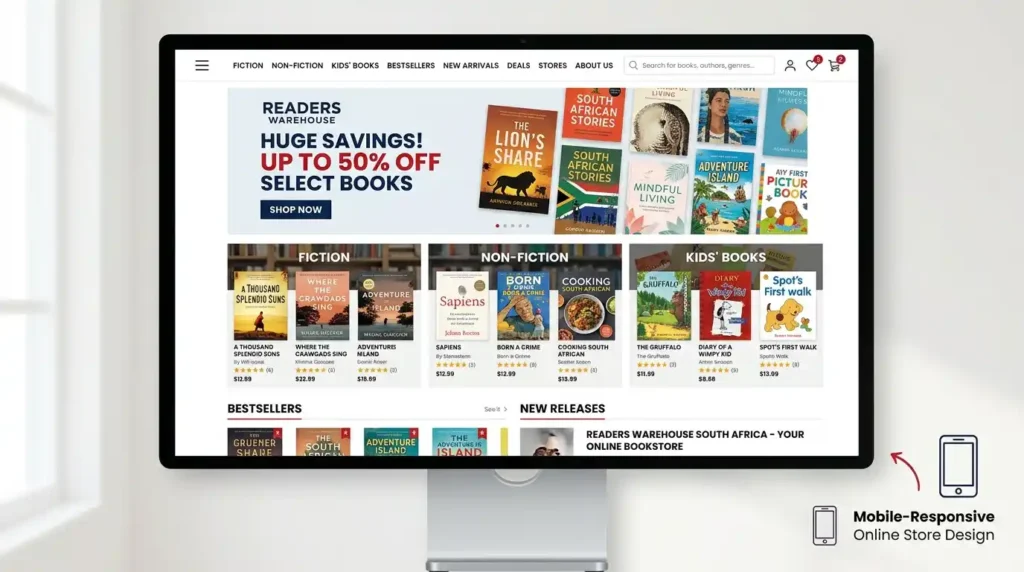
Readers Warehouse sells across many categories, but children’s reading and education are particularly visible in its online navigation.
Customers can browse by age, from babies and toddlers through to teenagers. They can also explore picture books, early readers, activity books, workbooks and Afrikaans children’s titles.
This is more than a long list of products. It gives different shoppers useful starting points.
A parent buying for a preschooler does not have to approach the catalogue like a literary researcher. A teacher looking for early-learning material can head towards a relevant category.
For a first-time ecommerce founder, that is an important distinction:
Having products is not the same as helping people choose products.
Organise your store around the questions your customers actually ask. Depending on your niche, that might mean shopping by age, size, purpose, compatibility, occasion or budget.
Thoughtful ecommerce website design should help people find the right item—not merely display everything you have available.
You do not need a huge catalogue to apply this lesson. A small, well-organised range is a sensible place to begin.
Readers Warehouse’s official company information describes physical stores and services in major South African centres, including Cape Town, Johannesburg, Durban, Pretoria and Port Elizabeth, now known as Gqeberha.
Alongside that physical presence, customers can browse and order through its online bookstore, with courier delivery and in-store collection options.
The significance for a startup is not that you need shops in several cities. It is that the customer’s need can remain consistent across different ways of buying.
Some people want to browse shelves. Others want to order from home. Some prefer collecting a parcel rather than waiting for a courier.
Readers Warehouse’s current model accommodates several of those preferences.
For a new entrepreneur, however, multiple channels should be an opportunity—not a demand to do everything at once.
Start with a sales process you can manage reliably. Add channels when you have the stock control, communication and fulfilment capacity to support them.
Growth should make your offer more accessible, not make your promises harder to keep.
Delivery Is Part of the Product
An online sale is not finished when the payment succeeds.
The customer still needs the order.
Readers Warehouse’s shipping policy distinguishes between different fulfilment arrangements:
- In-stock items: dispatched within 1–3 business days.
- Special orders and imported titles: a stated timeframe of 7–10 business days.
- Branch collection: available within 5–10 working days.
The policy also describes courier delivery, Pargo collection and Bob Box collection options, with estimated delivery dates shown at checkout.
Importantly, dispatch within 1–3 business days is not a promise of delivery within that period.
That distinction is worth remembering when writing your own store’s policies. Customers need to understand when you will send an order, how it will travel and when they can reasonably expect it.
For your startup, make these details easy to find:
- Whether the product is available.
- What delivery or collection will cost.
- How long processing usually takes.
- How customers receive tracking information.
- Who to contact if something goes wrong.
Trust is built through clear expectations and consistent follow-through, not just reassuring words beside a checkout button.
Looking Beyond the Individual Shopper
Readers Warehouse also shows how a retail offering can serve organisations as well as individuals.
Its School Program supports bulk book buying for South African schools, including classroom libraries, prescribed reading and learner rewards.
The published programme offers tiered discounts on standard-priced titles, with custom quotations for larger orders. It also accommodates school purchasing needs through quotations, pro-forma invoices and nationwide delivery.
This does not prove how much institutional sales contribute to the business. It does demonstrate a separate, clearly structured way for schools to buy.
For an ecommerce startup, that opens a useful line of thought.
Who else needs what you sell?
A stationery business might serve individual shoppers and small offices. A craft supplier might serve hobbyists and workshop organisers. A specialist clothing store might serve consumers and clubs.
You do not have to launch a wholesale operation immediately. Start by making it easy for a suitable organisation to ask for a quotation.
Sometimes growth means finding another customer for the products you already understand.
Is Readers Warehouse Still in Business?
Its accessible online catalogue, published shipping arrangements and School Program support describing Readers Warehouse as currently trading.
Its official information also describes a physical retail presence across several South African cities.
That is enough to establish a continuing retail and ecommerce operation. It does not, by itself, establish current profitability, market leadership or an active expansion programme.
The encouraging part of the story does not need those extra claims.
A family-owned business with a clear affordability mission now serves customers through several purchasing and fulfilment options. For a new founder, there is plenty to learn from that.
What First-Time Ecommerce Founders Should Take Away
Readers Warehouse offers a practical set of lessons—not a formula that guarantees the same outcome.
| Strategic area | What the example shows | What a startup can apply |
|---|
| Positioning | A clear commitment to affordable books | Give customers a specific reason to choose you |
| Customer focus | Visible routes for families, readers and educators | Organise your offer around real customer needs |
| Merchandising | Clearance sections, bundles and displayed savings | Make value easy to understand |
| Fulfilment | Published dispatch and collection arrangements | Promise only what you can reliably deliver |
| Sales channels | Consumer shopping alongside a school programme | Explore suitable organisational buyers |
The common thread is consistency. The products, pricing presentation, browsing experience and delivery information should support the same customer promise.
If you need help translating that promise into practical decisions, ecommerce business coaching can provide a place to work through your niche, offer and growth priorities.
Common Mistakes First-Time Entrepreneurs Should Avoid (Lessons from Readers Warehouse)
- Mistake: Waiting for a "big launch" instead of testing small. Readers Warehouse proved demand at flea markets first.
- Mistake: Ignoring niche focus. The brand never tried to be a general retailer, it stayed firmly in the discount lane.
- Mistake: Underestimating institutional sales. The School Program shows bulk B2B-style sales can be a stable growth channel.[9]
Your First Order Is a Beginning, Not a Small Achievement
You do not need an established retailer’s scale to take your first step. Focus on building a business that earns trust, one order at a time:
- Start small and focused. Choose a manageable product range for a clearly defined customer.
- Know your costs. Include packaging, payment fees and delivery before setting your prices.
- Make buying easy. Use clear product descriptions, visible delivery costs and a checkout you have tested.
- Keep your promises. Communicate honestly and deliver within the timeframes you advertise.
- Learn and keep improving. Ask early customers for feedback and use it to make the next order better.
Your first order isn't the end of the journey - it's the opportunity to earn the next one.
Ready to build a high-converting e-commerce store that keeps customers coming back?
Contact WEBS today to scale your online store.
References
- readerswarehouse.co.za. readerswarehouse.co.za.
- About US. readerswarehouse.co.za.
With over 21 years of experience, I specialise in designing and developing custom e-commerce websites and mobile apps for clients seeking to establish an online presence. I assist clients in building tailored e-commerce solutions and provide training on managing the backend, empowering them to run their online businesses independently.
Read more at
Linkedin