Choosing an E-Commerce Support Agency South Africa Businesses Trust
Last updated: October 18, 2026
A store that handled 50 orders a week last year is now drowning in 500 orders a day, and the free theme that once felt like a bargain is the reason checkout just timed out. That is the moment most founders start searching for an e-commerce support agency South Africa teams can rely on, instead of patching things themselves at midnight.
Quick Answer
DIY platforms work well for testing an idea, but they struggle once order volume, traffic, and compliance demands grow. Businesses that scale typically need managed WooCommerate hosting South Africa providers or Shopify maintenance and support services SA can supply, because self-managed setups were never built for high-volume, mission-critical retail [2][14].
Key Takeaways
- South African online retail is set to reach R159 billion in 2026, growing 22.5% year-on-year, which puts pressure on entry-level hosting [2][4].
- Over 77% of purchases happen on mobile, so DIY themes that are not performance-tuned lose sales fast during traffic spikes [10][13].
- Cart abandonment in South Africa sits around 83%, roughly 13 points above the global average, and slow checkouts make it worse [13].
- A lean DIY WooCommerce setup can cost around R350 a month, while agency-supported Shopify or advanced builds commonly run R3,000 to R15,000 a month before marketing [14][7].
- Managed hosting plans start from roughly R250 a month locally, bundling backups, updates, and uptime monitoring [9].
- Choose a full-service e-commerce agency Cape Town / Johannesburg option if you need marketing, design, and technical support together, not just server fixes.
Can I manage an e-commerce site myself, or do I need an agency?
Solo founders can run a store themselves while order volume stays low and simple, but this becomes risky once sales, integrations, and customer data grow. A one-person or small team setup is fine for testing a product idea; it is not fine for a business processing daily transactions, card payments, and customer records [14].
- Choose DIY if: you are pre-launch, testing demand, and handling fewer than 50 orders a month.
- Choose an agency if: you process payments daily, store customer data under POPIA, or have missed sales due to downtime.
A common mistake is waiting until a crash happens before looking for help, rather than planning the handover in advance.
What happens to WooCommerce when you get too many orders?
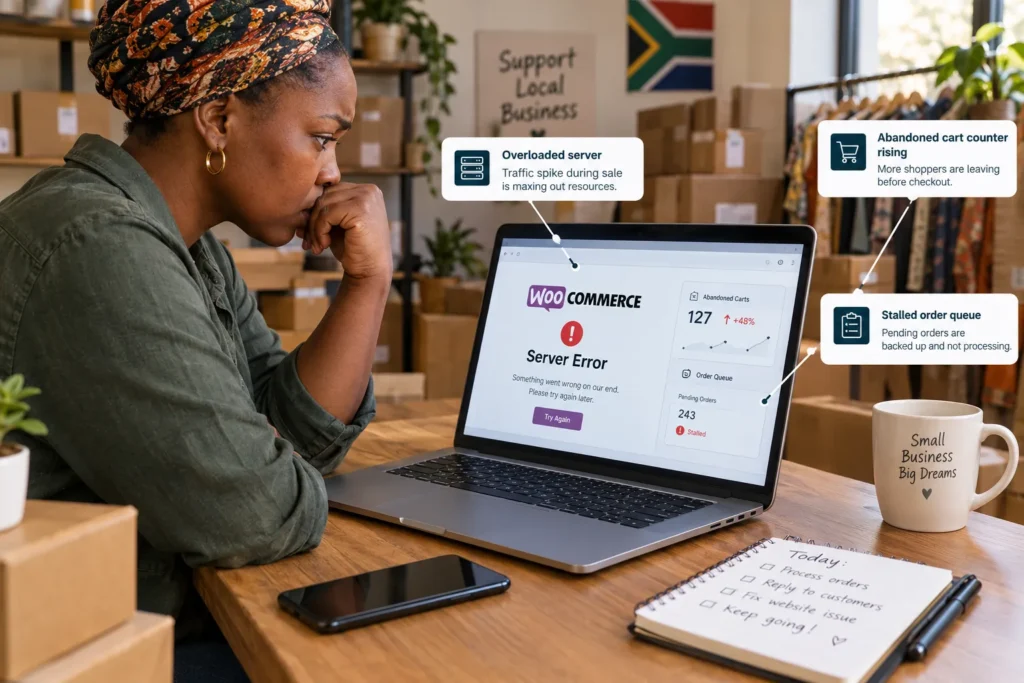
WooCommerce runs on shared hosting resources, so a sudden spike in orders can max out server memory, slow the database, and crash checkout entirely. This is especially common during sales, when plugins for payments, stock, and email all compete for the same limited server capacity [14].
If a platform crashes mid-sale, every abandoned cart during that window is a lost sale that is hard to recover, since South African shoppers already abandon carts at a high rate [13]. Moving to managed WooCommerate hosting South Africa providers offer (VPS or dedicated tiers) resolves this before it happens, because capacity is planned ahead of peak traffic rather than reacted to afterward [14].
Why does my Shopify store slow down during peak sales?
Shopify slows down when themes are overloaded with apps, images are unoptimized, or traffic exceeds what the chosen plan's infrastructure handles well. Even hosted platforms like Shopify are not immune to performance drag if the store itself is poorly configured [10].
With more than half of South African shoppers buying from a phone, a few extra seconds of load time directly increases bounce and abandonment [3][10]. Shopify maintenance and support services SA providers typically audit app bloat, compress images, and streamline checkout flows so peak-season traffic does not tank conversion rates.
How do I know when my DIY e-commerce setup is no longer working?
The clearest sign is recurring, avoidable problems: broken plugins after updates, slow page speed, failed payment integrations, or support tickets you cannot resolve quickly. If fixing the store is taking time away from sourcing product or running marketing, the DIY phase has ended [6][14].
Common mistakes at this stage include:
- Delaying security patches because "it's working fine for now"
- Ignoring mobile speed scores
- Running sales without load-testing checkout
- Storing customer data without a clear POPIA compliance process
Which is better for scaling, WooCommerce or Shopify in South Africa?
Neither platform is universally better; the right choice depends on how much control you want versus how much you want handled for you. WooCommerce gives full control but needs active server management, while Shopify handles infrastructure but limits deep customization [6][14].
| Factor | WooCommerce | Shopify |
|---|
| Hosting control | Full, but you manage it | Handled by Shopify |
| Update responsibility | Yours or an agency's | Mostly automatic |
| Local payment gateways | Flexible plugin support | Good, growing support |
| Best for | Stores wanting customization | Stores wanting less technical overhead |
What's the difference between managed hosting and regular hosting for online stores?
Regular shared hosting splits server resources across many sites with minimal monitoring, while managed hosting includes active monitoring, backups, security patching, and support built specifically for e-commerce traffic patterns. Shared hosting suits under 1,000 visits a day; above that, performance drops noticeably [14].
Online store website hosting and maintenance South Africa packages typically add daily backups, SSL renewal, uptime alerts, and software upgrades as standard, not as extras you have to remember yourself [9][8].
Do I need a full-service agency or just technical support for my store?
Technical support alone covers hosting, security, and bug fixes, while a full-service agency also handles design, marketing integration, and strategy. The right fit depends on whether your bottleneck is purely technical or broader than that.
A full-service e-commerce agency Cape Town / Johannesburg founders often choose is best if you lack an in-house marketer or designer too, not just a developer. If technical stability is your only gap, a focused maintenance retainer may be enough.
What services should an e-commerce support agency include?
A solid agency should cover hosting, security, backups, performance, and integration support as a continuous service, not a one-time fix. Maintenance is ongoing because software, threats, and traffic patterns change constantly [7][9].
Core services to expect:
- Secure, scalable hosting with uptime monitoring
- Daily or scheduled backups
- Plugin, theme, and software updates
- SSL and domain management
- POPIA-aligned data handling
- Integration support for payments, shipping, and inventory tools
How much does it cost, and is outsourced e-commerce management worth it?
Costs vary by platform and complexity, with basic managed hosting from around R250 a month and fuller retainers starting near R5,000 a month for more complex stores [9][7]. Whether it is worth it depends on how much revenue downtime or slow performance is already costing you.
Outsourced e-commerce website management South Africa services generally pay for themselves once a store processes regular daily orders, because the cost of a failed sale event during a peak campaign usually exceeds a month of support fees [13][14].
What support do you need as your online store grows, and can a small team handle it alone?
A small team can handle early growth, but as order volume, integrations, and compliance needs expand, most teams need external support for hosting, security, and performance work. South Africa's online retail market is expected to pass 12% of total retail turnover by 2027, meaning the infrastructure demands on serious stores will keep rising [6].
Growth stage guide:
- Launch: DIY is usually fine.
- Early growth: Add managed hosting and basic maintenance.
- Scale phase: Bring in an agency for hosting, security, and integrations together.
FAQ
Is Shopify or WooCommerce easier to scale in South Africa?
Shopify is generally easier to scale with less technical effort, since hosting is managed for you; WooCommerce offers more control but needs active server management as traffic grows [6][14].
What happens if my store crashes during a big sale?
Every minute of downtime during a sale typically means lost orders and abandoned carts, which is costly given South Africa's already high cart abandonment rate [13]. Read rebuilding an eCommerce Store
Do I need POPIA compliance for a small online store?
Yes, any business collecting customer data, including names, addresses, and payment details, needs a clear data protection process under POPIA [9].
How much does managed WooCommerce hosting cost in South Africa?
Pricing ranges from shared hosting at the low end up to VPS and dedicated hosting for high-volume stores, with costs scaling alongside traffic and order needs [14].
Can I switch from DIY to an agency without downtime?
Yes, a planned migration with proper backups and testing can be done with minimal or no downtime if scheduled outside peak sales periods.
What is the biggest mistake first-time store owners make when scaling?
Delaying maintenance and security updates until a problem forces action, rather than planning for growth in advance [14].
Why Partner with Webs.co.za to Build, Host & Scale
DIY platforms are a reasonable starting point for testing an idea, but scaling in South Africa’s R159 billion e-commerce market requires dependable hosting, tight security, and ongoing technical maintenance [2][4][6]. When plugin updates, slow mobile checkout speeds, and server downtime start eating into time better spent on marketing and product sourcing, partnering with an experienced local agency becomes essential [8][9]. With over 20 years of experience, Webs.co.za [8] delivers custom-built WooCommerce and Shopify stores backed by high-performance managed hosting, local payment gateway integrations (PayFast, Ozow, Yoco), and personalized 1-on-1 backend coaching.
Ready to stop fixing technical glitches and focus on growing your business? Contact us today to get a custom build, host, and support quote, and launch a fast, high-converting online store in as little as 5 to 9 days.
References
With over 21 years of experience, I specialise in designing and developing custom e-commerce websites and mobile apps for clients seeking to establish an online presence. I assist clients in building tailored e-commerce solutions and provide training on managing the backend, empowering them to run their online businesses independently.
Read more at
Linkedin