Managed eCommerce Hosting In South Africa
Updated February 2026
Online shopping in South Africa keeps growing, and with a global cart abandonment rate of 70.22% in 2026, any weakness in your store’s design, hosting, or maintenance can cost you real sales. We see more local businesses moving online every month, which makes robust, managed hosting a core requirement rather than a nice-to-have.
Key Takeaways
| Question | Answer |
|---|
| What is managed eCommerce hosting in South Africa? | It is a hosting service where a specialist team manages server performance, security, backups, and updates for your online store, so you can focus on sales and operations. Our eCommerce design, hosting and maintenance overview explains this full ecosystem. |
| Why does design, hosting and maintenance need to work together? | Because design affects how shoppers use your store, hosting controls speed and uptime, and maintenance keeps everything secure and updated. When these align, you get a smoother shopping journey and fewer abandoned carts. |
| How do I get a fully managed online store quickly? | We provide a complete eCommerce solution with design, hosting, payment integration and ongoing support, so you can launch a store without building everything from scratch. |
| Can managed hosting integrate with ERP and POS systems? | Yes, our ERP integration services connect your store to inventory, accounting and POS tools so stock and pricing stay in sync across channels. |
| Is a SaaS approach suitable for growing eCommerce brands? | For many businesses, yes. Our cloud-based Software as a Service model gives predictable monthly costs and zero server maintenance on your side. |
| Where can I learn more about online store design trends in South Africa? | Our eCommerce web design articles cover local online retail trends, performance tips and hosting best practices for South African stores. |
| How important are payment gateways for managed hosting setups? | Critical. Your store must work smoothly with local gateways like PayFast and other fintech tools, which we track closely in our payment gateway insights. |
1. Why Managed eCommerce Hosting Matters In South Africa Today

South African consumers are shopping online more, from groceries to fashion to specialist products, and they expect sites to load quickly on both fibre and mobile data. As more spaza shops and traditional retailers go digital, competition increases, which means the quality of your design, hosting and maintenance directly affects whether customers stay, buy, and return. We see two types of hosting choices in the local market: basic, unmanaged hosting and fully managed eCommerce hosting. Unmanaged hosting may look cheaper on paper but usually leaves store owners dealing with downtime, slow pages and security threats on their own. Managed hosting, especially for South African eCommerce, combines optimised servers, security layers, backups and proactive support that understands local conditions like bandwidth, traffic spikes on payday, and regional payment gateways. In this article, we look at the main pros and cons of managed eCommerce design, hosting and maintenance so that you can decide what makes sense for your store.
2. Pro: Fast, Reliable Performance For Busy Online Shops
Managed hosting is built for speed and uptime, which is essential when even a 100 millisecond delay can reduce revenue by about 1 percent on high traffic stores. In South Africa, where many customers still browse and buy on mobile data, every second of page load time counts even more. Good managed hosting solutions are tuned specifically for eCommerce platforms, caching, content delivery and database performance, which keeps product pages and checkout stable when you run promotions or load-shedding shifts demand online. We also design responsive, user friendly stores that work well with these hosting setups, so design and hosting reinforce one another rather than compete. From our perspective, performance is not only about server hardware, it is about a complete stack that includes front end code, images, database structure, and the way your theme interacts with the platform. This is why we prefer managed hosting that we control, so we can diagnose and fix bottlenecks across the full system instead of guessing around the edges.
3. Con: Higher Monthly Cost Than Basic Hosting
The main drawback of managed hosting is cost, because you are paying for both infrastructure and a specialist team that manages it for you. Basic shared hosting packages look attractive for startups that want to minimise monthly expenses, but they shift the risk and workload onto you. If your store goes down on a Friday night or your checkout fails on payday, you are the one who must troubleshoot logs, call generic support lines and hope for a quick resolution. Managed hosting usually includes performance tuning, daily backups, uptime monitoring and security patching, which lowers your operational risk but raises your fixed monthly cost. We see this as a trade off: slightly higher predictable fees in exchange for protection against expensive downtime and data loss incidents. For serious eCommerce, especially when you handle card payments and personal data, that trade off is usually worth it once revenue reaches even a modest level.
4. Pro: Security, Updates And Ongoing Maintenance Included
Security is one of the most overlooked parts of eCommerce in South Africa, especially for small and medium stores. Yet you are responsible for protecting your customers’ data, transactions and passwords, regardless of your hosting choice. Managed hosting centralises critical maintenance tasks like updating your shopping cart software, patching plugins, rotating keys, and scanning for malware or suspicious login attempts. We routinely see self hosted sites running outdated versions of their cart platform or payment plugins, which exposes them to known vulnerabilities that criminals already know how to exploit. With a managed approach, you get scheduled software updates, daily or hourly backups, and a plan for what to do if something goes wrong, so you are not trying to rebuild a site from scratch after a hack. This is particularly important when you work with local gateways and banks that expect you to maintain secure, compliant environments.
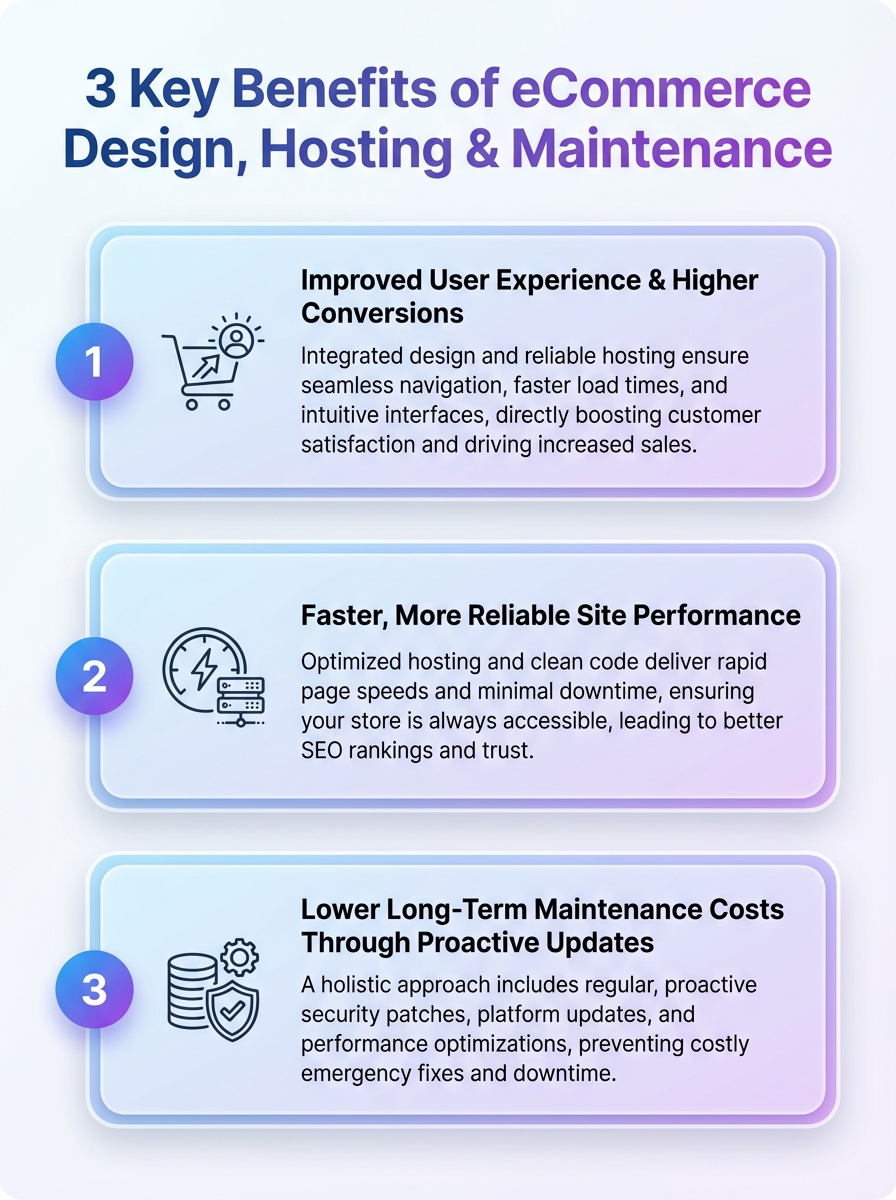
Explore three core benefits of integrating eCommerce design, hosting, and maintenance for your online store. Learn how each pillar improves performance, security, and conversions.
5. Con: Less Direct Control Over Technical Configuration
With managed hosting, you give up some low level control in exchange for stability and support. You typically cannot tweak every server setting or install any software you like, because the provider must protect all customers on the platform. For most South African eCommerce shops, this limitation is not a problem, because the standard stack already covers caching, PHP versions, image handling, backups and security. However, if you have very specific integration needs or custom software that requires exotic server modules, you may find managed platforms too restrictive. In those niche cases, a custom dedicated server might be more suitable, but it also demands deeper technical knowledge and bigger budgets. We usually recommend managed hosting for the majority of retailers, and only look at custom infrastructure when there is a clear technical or regulatory reason.
Did You Know?
Downtime is costly: hosting uptime of 99.9% implies about 8.76 hours of annual downtime, while 99.99% uptime is even more protective of your online revenue.
Source: UMA Technology
6. Pro: Scalability For Growing Traffic, Products And Orders
As South African brands grow, they often hit limits on entry level hosting that was never meant to handle thousands of SKUs or heavy promotion traffic. Managed hosting is built with scalability in mind, so you can add products, content and concurrent users without rewriting your entire stack. Our approach to scalability covers both infrastructure and store design. We keep themes efficient, compress assets, and configure databases correctly so that when your host adds more CPU or memory, your site can actually benefit. Scalability also applies to your business model, for example if you launch a multi vendor marketplace, add subscription billing, or integrate with external stock feeds. A managed environment with proper monitoring makes it easier to plan capacity and budget for growth, rather than react to crashes.
7. Con: Migration Effort From Legacy Or DIY Platforms
If you already run a store on a different host or platform, moving to managed hosting requires planning and effort. You need to move databases, product images, customer accounts and order history without disrupting your live store. We handle migrations as carefully planned projects with staging environments, testing and scheduled cutovers to reduce risk. However, there is still some downtime risk and temporary complexity, especially if your old site uses heavy customisation or unmaintained plugins. The short term downside is the time and cost of migration. The long term upside is a cleaner, faster, more secure platform that you can maintain more easily.
Did You Know?
For every 1 second improvement in page load time, conversions can increase by about 2 percent, which shows how closely performance, hosting and revenue are connected.
Source: Conductor / Walmart Data
8. Pro: Local Payment Gateway And Mobile Commerce Readiness
South African eCommerce depends heavily on local payment gateways, mobile usage and trust in online payments. Your hosting and maintenance setup must support reliable integrations with gateways like PayFast, PayPal and emerging fintech services. We design and host stores that handle redirects, callbacks and notifications correctly, which is critical for reconciling orders when customers pay via card, instant EFT or wallet solutions. Managed hosting also helps with SSL management, secure headers and encryption, which directly affects how safe customers feel on your checkout pages. Since many South Africans complete purchases on mobile devices and lower bandwidth connections, we focus on lean design, compressed images and minimal blocking scripts on hosted platforms. That combination of performance hosting, careful checkout design and strong payment gateway integration is often what separates stores that convert from those that lose customers at the last step.
9. Con: Vendor Lock In And Dependency On Support Quality
A managed hosting relationship is a long term partnership, which means you are trusting one provider with a critical part of your business. If support quality declines or the platform stagnates, you may feel locked in because migration looks difficult. We are very aware of this concern from a client perspective, which is why we favour open source shopping cart systems and standard technologies that make it possible to migrate if you ever need to. Vendor lock in is less about the technical platform and more about how data is stored and how willing your host is to help with exports and transitions. We recommend that store owners regularly review performance, uptime, response times and communication from their managed host. If you notice consistent issues, it is better to address them early, while migration is still manageable.
10. Pro: Integrated Design, Hosting And Maintenance As A Strategic Advantage
When your design, hosting and maintenance are handled by one experienced team, your eCommerce operations become simpler and more predictable. We see this integrated approach as a competitive advantage in a South African market where many stores still use disconnected freelancers, generic hosts and ad hoc support. From our side, it allows us to think about your store as a single system, from UX and UI through to ERP integration, SaaS tools and stock control. For example, our work on ERP linked stores connects your inventory, pricing and POS to the same platform that your customers use, which lowers human error and speeds up order processing. We also provide training and support so your team can manage products, orders and content confidently, while we handle the underlying technical complexity. For businesses that want to start selling online quickly, we offer fully built, hosted and managed online stores, so you can launch, run and grow a professional eCommerce presence without taking on the technical burden yourself.
Conclusion
Managed eCommerce design, hosting and maintenance give South African businesses a robust foundation for selling online, with strong benefits in performance, security, scalability and support. The key pros include faster sites, better uptime, proactive updates, mobile and payment gateway readiness, and the peace of mind that comes from expert 24/7 assistance, while the main cons are higher monthly costs, less low level control, migration effort and some dependency on your provider.
For startups, managed hosting reduces technical risk and lets founders focus on product, marketing and customer service instead of servers. For established brands, it protects revenue and brand reputation by reducing downtime, data breaches and performance issues. If you are planning or upgrading an online store in South Africa, we recommend looking closely at managed hosting options, comparing service levels, technology stacks and support responsiveness against your growth plans.
When you are ready, contact us to discuss a managed plan that fits your eCommerce needs so we can design, host and maintain a store that keeps up with your customers and your ambitions.
Contact us for a complete web design and hosting service.
With over 21 years of experience, I specialise in designing and developing custom e-commerce websites and mobile apps for clients seeking to establish an online presence. I assist clients in building tailored e-commerce solutions and provide training on managing the backend, empowering them to run their online businesses independently.
Read more at
Linkedin